
55 Bodies Found Decomposing Inside Chicago Funeral Home After Months of Complaints
Investigators found 55 improperly stored bodies at South Chicago Chapel. Earlier complaints, regulatory failures, and unanswered family questions remain under investigation.
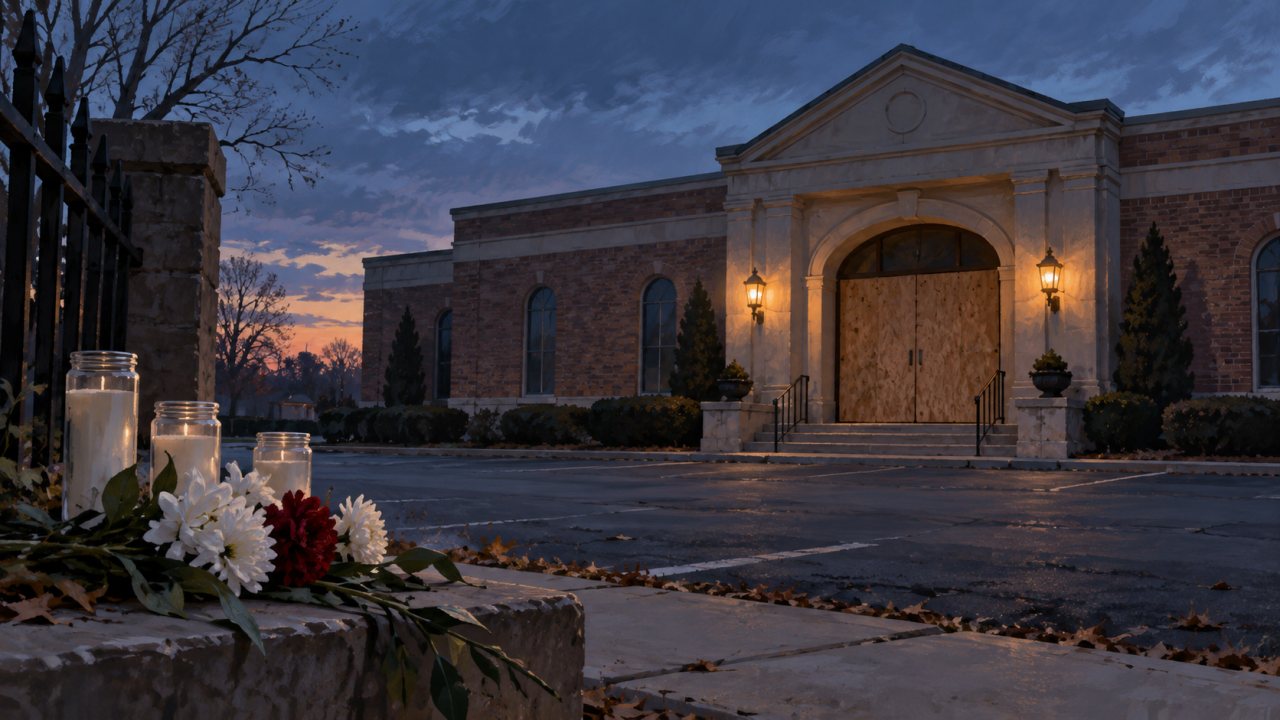
Editorial illustration, not documentary imagery.
In August 2026, authorities discovered 55 bodies decomposing inside a Chicago funeral home, with evidence of rodent infestations, maggots, and inadequate refrigeration. The operators had previously run another crematory shut down over mishandled remains. Families are now demanding answers about why regulators did not intervene sooner.
A Horrible Smell Coming From the Funeral Home
For months, residents of Chicago's South Deering neighborhood complained about a foul odor coming from South Chicago Chapel at 2939 East 95th Street.
Neighbors described the smell as resembling a dead animal. Some said it was especially noticeable when people entered or exited the funeral home.
The odor was accompanied by increasing numbers of flies around the building.
Residents reported the conditions to local authorities, but the funeral home continued operating.
On August 6, 2026, Chicago police officers arrived at the property to assist the Illinois Department of Financial and Professional Regulation with a licensing investigation.
Authorities had received information that human remains inside the building were not being stored at legally required temperatures.
What investigators discovered was far worse than an improperly maintained refrigeration system.
Dozens of bodies were located throughout the funeral home, including storage areas, closets, and a garage.
Many were in advanced stages of decomposition.
State regulators documented rodent activity, maggots, and severely inadequate storage conditions.
The Cook County Medical Examiner's Office was called in to recover and identify the remains.
The initial count was 56 bodies. On October 14, forensic investigators corrected the number to 55 after determining that a separate bag of organs belonged to one of the deceased individuals already counted.
Bodies Stacked in a Storage Room
The physical conditions became clearer when Chicago filed a civil lawsuit against the funeral home's operators.
According to the city's complaint, investigators found 51 bodies concentrated in a rear storage room.
Approximately half were inside a cooler that was not functioning adequately. The others were improperly arranged around the storage area, many in advanced decomposition.
Investigators reported overwhelming odors, large numbers of flies, and rats.
The building was not equipped or maintained to handle remains under those conditions.
Illinois regulations require the proper refrigeration or preparation of bodies held for funeral services. The police report obtained by the Chicago Sun-Times indicated that officers were investigating allegations that bodies were not being maintained at or below 40 degrees Fahrenheit.
The problem extended beyond refrigeration.
The city's lawsuit identified 23 alleged building code violations, including unsanitary conditions, work performed without permits, and missing fire-safety equipment.
Chicago sought fines of ,500 per day until the violations were corrected.
The funeral home was shut down, and the bodies were transferred into the custody of the medical examiner.
A Funeral Was Taking Place as Police Arrived
One of the families directly affected was that of Latasha Johnson.
On August 6, Johnson had attended her mother's funeral at South Chicago Chapel.
After the service, family members discovered that police vehicles were blocking their cars.
Johnson initially believed something had happened elsewhere in the neighborhood.
She later learned that investigators had discovered dozens of decomposing bodies inside the same funeral home where her mother's service had just taken place.
Johnson told the Chicago Sun-Times that she had trusted the funeral home with her mother's remains and paid for the services.
The discovery left her questioning how her mother had been treated.
Other families reported problems even before police arrived.
Relatives of Keith Allen Young said they had waited for hours for his body to be delivered to a church for a scheduled wake. The body never arrived, and the family said its calls to the funeral home went unanswered.
Another customer, Lakina Staples, said her family had not received her aunt's remains despite paying for services.
For these families, the investigation was not simply about conditions inside a commercial building.
They were trying to establish whether the bodies entrusted to the funeral home had been properly handled and whether promised services had actually been performed.
Investigators Discover 56 Boxes of Cremated Remains
The investigation produced another significant discovery.
On August 10, the Chicago Sun-Times reported that authorities had recovered 56 boxes of cremated human remains from South Chicago Chapel.
These were separate from the 55 bodies eventually confirmed by the medical examiner.
Police transferred the boxes to the Cook County Medical Examiner's Office, while investigators worked to determine their ownership and contact relatives.
Their discovery raised additional questions about recordkeeping, cremation procedures, and whether families had received the remains of their loved ones.
The existence of the boxes did not, by itself, prove that every set of ashes had been mishandled or misidentified.
However, the broader investigation made it necessary to examine the funeral home's documentation and chain of custody.
Some families who had already received cremated remains also began questioning whether those ashes were correctly identified.
Among them were relatives of Shawnese Shannon, whose family used services associated with the funeral home operators.
Her daughters, Marshawna and Franquella Campbell, described inconsistent information surrounding their mother's cremation and the delivery of her ashes.
As of October 2026, the family remained concerned about whether the remains they received actually belonged to their mother.
The Owners Had Already Been Investigated at Another Crematory
The funeral home's operators were identified as Johanna Morgan and her husband, Clark Morgan.
Johanna incorporated South Chicago Chapel in 2022. Clark was listed as the company's president and was identified in subsequent reporting as its owner.
The couple's regulatory history immediately attracted attention.
They had previously operated Heights Crematory in Chicago Heights, Illinois.
In February 2025, the Illinois Comptroller's Office began investigating that business after receiving information about improperly stored bodies.
Investigators initially found approximately 100 bodies awaiting cremation.
They also discovered a refrigerated trailer that management had not initially disclosed. The trailer contained 19 additional bodies from Indiana.
Authorities identified serious problems involving storage conditions, missing documentation, and delayed cremations.
Hundreds of boxes of cremated remains had not been returned to their families.
The Comptroller's Office ultimately documented at least 44 mishandled bodies and 504 sets of cremated remains associated with the investigation.
The state moved to revoke Heights Crematory's license, and the facility permanently closed in June 2025.
The Morgans agreed to the closure but did not admit wrongdoing under the agreement.
Illinois Comptroller Susana Mendoza's office referred its findings to law enforcement and urged additional regulatory action against the operators.
Nevertheless, South Chicago Chapel continued to operate until August 2026.
Authorities Had Received Complaints Long Before the Discovery
One of the most consequential findings emerged from reporting by Illinois Answers Project and Capitol News Illinois.
The journalists obtained records showing that city officials had received complaints concerning South Chicago Chapel well before August 2026.
In September 2025, an alderperson's office contacted the city about foul odors and the operators' previous problems at Heights Crematory.
A city inspector visited following a complaint concerning burning garbage.
The inspection lasted approximately 20 minutes.
The inspector photographed the property, including an empty gurney in the parking lot. His written report indicated that the odor came from a garbage can that had been burned outside.
The available record did not show that he entered the funeral home.
The complaint was closed.
Later that month, the alderperson's office requested information about the funeral home's licensing status.
The city responded to the licensing inquiry but did not refer the concerns about the operators to the state agency responsible for regulating funeral directors.
Meanwhile, state regulators had previously visited properties associated with the Morgans.
According to an official timeline, regulators examined South Chicago Chapel in October 2025 and reported no serious concerns concerning the storage or handling of human remains during that inspection.
The contrast between those earlier findings and the conditions discovered in August 2026 raised substantial questions about oversight.
It has not been established exactly when all 55 bodies began accumulating inside the building, or whether each was already there when earlier complaints were submitted.
The Investigation Expands to Other Funeral Businesses
The discovery at South Chicago Chapel prompted investigators to examine additional businesses connected to the Morgans.
Among them was Planet Green Cremation, a funeral services business in the south suburbs.
Authorities executed a search warrant at a Planet Green location in September 2026. Police were observed removing boxes, although the department did not publicly explain the contents.
The Illinois Comptroller's Office also investigated Bohemian National Cemetery and Crematorium in connection with the wider case.
Families began reviewing paperwork, receipts, cremation certificates, and records from multiple businesses.
Some discovered that different businesses involved in arranging and performing cremations had connections to the same operators.
These developments complicated efforts to establish what had happened to individual remains.
A family might have arranged services through one business, had the body transported through another, and received documentation identifying a third cremation facility.
Investigators were consequently examining more than the physical conditions inside a single funeral home.
They were also assessing how records and remains moved through the connected businesses.
All 55 Bodies Finally Identified
The Cook County Medical Examiner's Office undertook an extensive identification operation after the bodies were recovered.
Investigators used fingerprints, dental records, medical imaging, visual identification, and DNA testing.
The state of decomposition made some identifications more difficult than normal.
On October 14, 2026, officials announced that all 55 bodies had been identified.
The final count corrected the original figure of 56 because forensic testing showed that a bag of organs belonged to one of the individuals already included in the total.
The identification milestone resolved a critical forensic question, but it did not settle every family's concerns.
Questions remained about the handling of cremated remains, delays in promised services, and whether all records accurately reflected what happened to each deceased person.
The Latest Developments: October 2026
On October 7, the Chicago Sun-Times reported that Johanna Morgan had formally denied the state's allegations against her, except for acknowledging that she had been the sole funeral director and embalmer at South Chicago Chapel.
Her license had been suspended on August 5, and state regulators were seeking permanent revocation.
The city also continued pursuing its building code lawsuit.
On October 23, Chicago inspectors returned to the building under a court order.
Representatives from the city's electrical, plumbing, carpentry, and demolition inspection divisions examined the property.
According to the city's Department of Buildings, the findings are expected to be presented to the court at a hearing on October 29.
Clark Morgan was present during the inspection.
As of October 25, 2026, the owners had not been criminally charged in connection with the South Chicago Chapel discovery.
Civil litigation, administrative licensing proceedings, and law-enforcement investigations were continuing.
Affected families were also receiving support from local crisis-response organizations.
The Larger Question: How Was This Allowed to Continue?
The discovery of 55 decomposing bodies inside South Chicago Chapel exposed failures that extended beyond one funeral home's storage practices.
The operators had previously been investigated at another facility.
Regulators had documented improperly stored bodies and hundreds of sets of cremated remains.
Neighbors had reported odors.
City officials had received complaints and information about the operators' history.
Yet the funeral home continued operating until the August 2026 investigation.
Illinois divides death-care oversight among multiple agencies. The Department of Financial and Professional Regulation regulates funeral directors and embalmers, while the Comptroller's Office oversees crematories and certain cemetery operations.
Local governments also enforce building and business regulations.
That division can complicate the sharing of information and enforcement responsibility.
The South Chicago Chapel investigation has renewed calls for stronger inspections, improved coordination among regulators, and more effective safeguards for families purchasing funeral services.
The essential facts are now established: 55 deceased individuals were found improperly stored, the operators had a documented history of regulatory problems at another facility, and repeated public complaints preceded the discovery.
The remaining questions concern accountability and the treatment of families whose loved ones were entrusted to these businesses.
For many affected relatives, the uncertainty did not end when investigators identified the bodies. They still want to know what happened after their loved ones were taken into the care of the funeral industry — and why the warning signs did not produce an earlier intervention.

Jude Cassian
Jude Cassian tracks the strange, dark, unexplained, and absurd corners of the world with independent curiosity and no political or religious spin.
Sources
Suggested Articles You Might Enjoy
The Enfield Horror: A Three-Legged Monster, Six-Toed Footprints, and the Illinois Town That Became a Cryptid Mystery
In 1973, an Illinois man reported a three-legged creature outside his home. A later sociological study examined how the Enfield Horror became an enduring cryptid legend.
The Devil House of Bolivia: A Home Covered in Demons Terrifies Neighbors, but Its Owner Says They Protect Him
David Choque covered his El Alto home with horned sculptures tied to Andean mining traditions. Neighbors feared occult activity, but the allegations were never substantiated.
An Eight-Foot Monster Lizard Took Over a Florida Family's Backyard and Evaded Capture for Months
Bamboo, an escaped eight-foot Asian water monitor, spent more than two months loose around homes in Davie, Florida, before wildlife officers captured it.
Reference
https://www.wwnytv.com/2026/08/07/horrible-smell-more-than-50-bodies-found-improperly-stored-decomposing-with-maggots-funeral-home/
Reference
https://chicago.suntimes.com/crime/2026/08/07/south-side-funeral-home-bodies-families-investigation
Reference
https://illinoiscomptroller.gov/newsroom/press-releases/comptroller-mendoza-files-complaint-to-revoke-license-of-the-heights-crematory
Reference
https://chicago.suntimes.com/news/2026/08/10/cremated-remains-ashes-found-south-chicago-chapel-funeral-home-95th-street-south-deering-decomposing-bodies
Reference
https://www.cbsnews.com/chicago/news/south-chicago-chapel-funeral-home-complaints-ald-peter-chico/
Reference
https://www.wbez.org/grave-injustice/2026/09/01/south-chicago-chapel-funeral-home-bodies-clark-johanna-morgan
Reference
https://news.wttw.com/2026/09/01/city-chicago-suing-south-chicago-chapel-where-dozens-decomposing-bodies-found
Reference
https://chicago.suntimes.com/grave-injustice/2026/10/07/south-chicago-chapel-director-denies-allegations-over-funeral-home-practices
Reference
https://chicago.suntimes.com/grave-injustice/2026/10/14/55-decomposing-bodies-found-in-south-chicago-chapel-identified
Reference
https://abc7chicago.com/post/city-inspecting-south-chicago-chapel-funeral-home-where-decomposed-bodies-were-found/19972657/
Reference
https://www.fox32chicago.com/news/chicago-support-families-affected-south-side-funeral-investigation