
The Devil House of Bolivia: A Home Covered in Demons Terrifies Neighbors, but Its Owner Says They Protect Him
David Choque covered his El Alto home with horned sculptures tied to Andean mining traditions. Neighbors feared occult activity, but the allegations were never substantiated.
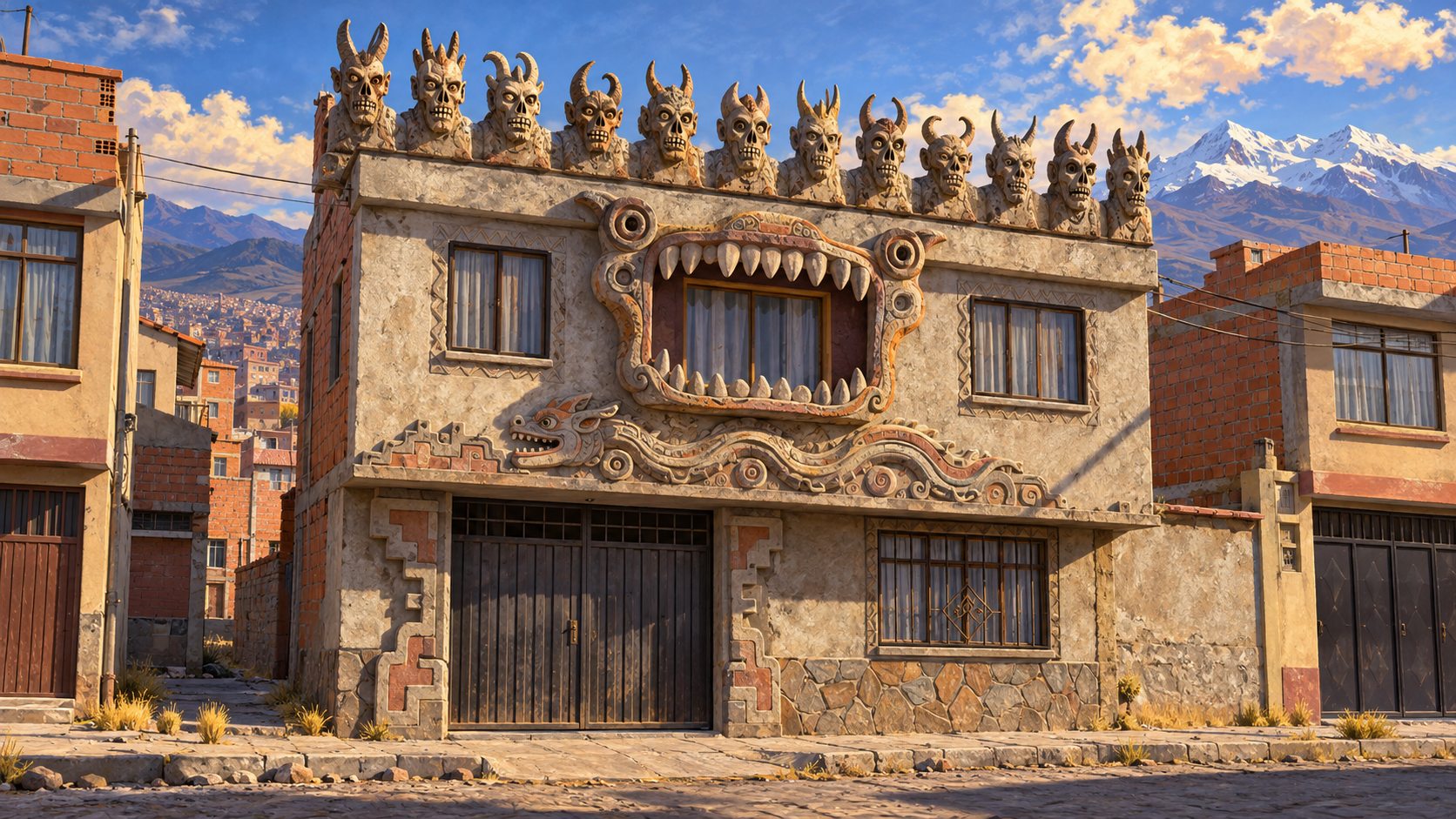
Editorial illustration, not documentary imagery.
In 2022, a homeowner in El Alto, Bolivia, covered his property with horned skeletons, monstrous faces, carved skulls, and a window resembling a creature's open mouth. Neighbors began spreading rumors about Satanic rituals taking place inside. But the owner, a former gold miner, offered a different explanation: the figures represented a centuries-old Andean spirit believed to protect miners working deep underground.
Twelve Demons Appear on a Residential Rooftop
In early 2022, residents of the 25 de Julio neighborhood in El Alto, Bolivia, noticed something unusual happening to a house belonging to local carpenter and former miner David Choque.
A row of horned figures had appeared along the property's exterior wall.
The sculptures resembled skeletal demons with elongated skulls, prominent teeth, hollow eyes, and enormous curved horns.
There were 12 of them.
Each had a different face, and Choque explained that the number represented the 12 months of the year.
The figures were not the only disturbing decorations.
A bedroom window had been transformed into the open mouth of a monster, complete with giant teeth and eyes. Beneath it, a dragon-like creature appeared to emerge from the wall.
The wooden entrance featured a horned face, skeletal hands, and other carved imagery.
To some residents, the property looked less like a family home and more like a building designed for a horror movie.
The decorations attracted curious visitors, photographers, and local journalists.
Others were considerably less enthusiastic.
Some neighbors believed the sculptures represented Satanic imagery and worried that the house was being used for occult ceremonies.
Choque denied the accusations.
According to him, the figures were associated with a supernatural guardian from Bolivia's mining traditions, not an attempt to invite evil into the neighborhood.
Neighbors Begin Spreading Rumors About Satanic Rituals
The unusual property attracted international attention on February 17, 2022, when Reuters journalist Monica Machicao published a report about the house.
The story included interviews with Choque and residents concerned about the decorations.
One neighbor, Maria Laurel, told Reuters she had heard rumors about people conducting rituals while naked inside the building.
She admitted that the stories frightened her.
However, she did not provide firsthand evidence establishing that such events had occurred.
Choque rejected the allegations.
He maintained that the decorations reflected his cultural background and personal beliefs.
The house was not intended as a place for Satanic ceremonies.
It was a tribute to a figure commonly known among Bolivian miners as El Tío — Spanish for "The Uncle."
For someone unfamiliar with Andean mining traditions, the distinction might not be immediately obvious.
El Tío is frequently depicted as a horned, devil-like figure.
But his significance is different from that of Satan in conventional Christian theology.
Who Is El Tío, the Underground Guardian of Bolivian Mines?
Deep inside Bolivia's mines, workers have long maintained shrines dedicated to El Tío.
The figure is understood in many mining communities as a powerful inhabitant or guardian of the underground world.
Miners traditionally regard him as someone capable of granting access to valuable minerals and offering protection from accidents.
He is also believed capable of bringing misfortune when neglected or disrespected.
Representations of El Tío often include horns, exaggerated facial features, and a frightening appearance.
Some statues are positioned inside mine tunnels or near entrances.
Workers may leave offerings of coca leaves, alcohol, tobacco, or other items.
These practices are associated with reciprocity: miners ask for protection and access to mineral wealth while acknowledging the spiritual forces they believe inhabit the earth.
The traditions vary across mining communities.
The imagery is also connected to Supay, a supernatural figure whose meaning changed through contact between Indigenous Andean religions and Spanish Christianity.
Historical interpretations of El Tío's origins are debated.
Researchers generally recognize that Indigenous concepts of underground beings and Spanish Christian depictions of the devil influenced how the figure developed.
The result is a supernatural character who may look frightening but is not understood in precisely the same way by everyone who encounters him.
For Choque, El Tío was a protector.
He had grown up in a mining family and spent years working underground.
The statues on his house represented that relationship.
A Former Gold Miner Explains His Unusual Beliefs
Choque was 42 years old when Reuters and several Bolivian newspapers interviewed him in February 2022.
He had previously worked at the Merma gold mine in the Mapiri region.
During that period, he became familiar with the custom of making offerings to El Tío.
By 2022, he had spent approximately a decade working in carpentry.
However, his connection to the mining tradition had continued.
According to an interview published by La Razón on February 7, Choque believed El Tío had helped protect him from accidents.
He continued asking the figure for protection in his workshop.
Choque also explained that he made daily offerings at the house.
A large representation of El Tío decorated the exterior wall of his bedroom.
Each day, according to local reporting, he placed a coca leaf near the figure, sprinkled alcohol, and asked for protection.
The practice was a continuation of rituals he had learned while working in the mines.
He did not believe the sculptures were dangerous.
Quite the opposite.
He considered them a way of expressing gratitude and maintaining an important relationship with the traditions of his family.
Inside the So-Called Devil House
Local journalists were eventually invited inside the property.
In a February 7 report originally published by Página Siete and reproduced by eju.tv, journalist Jorge Quispe described visiting the approximately 200-square-meter residence.
The house contained a carpentry workshop where Choque worked alongside relatives.
The interior also featured decorative representations associated with El Tío.
One of the most elaborate was the enormous face surrounding the bedroom window.
The window itself resembled a mouth with sharp teeth.
A dragon sculpture was positioned below it.
Choque reportedly slept in the room behind the monstrous facade.
He explained that each horned head along the exterior wall had been individually designed.
Some had larger teeth. Others had longer faces or different expressions.
The figures were not identical factory-made decorations.
They were handcrafted artworks using materials such as cement, stone, clay, and wood.
The sculptures had been installed during the preceding months, with work on the property beginning around August 2021.
Choque planned to add more figures as construction continued.
The unusual house was still an active project when journalists visited.
The Young Artist Behind the Monsters
By May 2022, additional reporting by Agence France-Presse identified one of the principal sculptors.
His name was Miguel Ángel Mamani.
He was 19 years old.
The young artist was responsible for producing the figures that stood along the wall of Choque's property.
Working with cement, stone, and clay, he created the exaggerated skeletal faces that gave the building its distinctive appearance.
Mamani also understood the figures as representations of the Andean underground world.
He described El Tío as a spirit associated with the depths of the earth.
The project therefore involved more than installing frightening decorations.
For the owner and artist, it was a way of bringing mining-related imagery into an urban environment where many people no longer worked underground.
For some observers, that imagery was culturally recognizable.
For others, it resembled a collection of demons looking down on the street.
The contrast helped explain why the property generated so much attention.
A Spiritual Consultation Room Was Also Planned
Choque initially intended the property to become more than an unusual residence.
According to La Razón, he planned to establish a spiritual consultation area.
His sister, Vicky Choque, was described as an amauta, a practitioner associated with traditional Andean spiritual knowledge.
She was expected to offer consultations and explain the cultural significance of El Tío.
Plans included card readings and traditional Andean offerings intended to request good fortune.
These proposals contributed to the property's unusual reputation.
However, spiritual consultation, traditional offerings, and the presence of horned sculptures do not establish that criminal or abusive rituals were taking place.
The claims involving naked ceremonies remained unsubstantiated rumors in the reporting.
Choque said he wanted visitors to enter without fear and learn about the traditions represented by the decorations.
The property was already attracting people interested in taking photographs.
The attention encouraged him to expand his plans.
The Devil House Was Going to Become a Museum of Fear
In May 2022, Agence France-Presse reported a new development.
Choque wanted to transform the property into a Museo del Miedo, or Museum of Fear.
The proposed attraction would feature unusual, frightening, and supernatural elements from Bolivian folklore.
The sculptures of El Tío would remain part of the display.
But Choque intended to expand beyond mining-related traditions.
He discussed adding representations of regional legends, including a supernatural cart said in some Bolivian stories to travel at night collecting wandering souls.
Other proposed subjects included the legendary siren of Lake Titicaca, a figure associated with folklore from the high-altitude lake shared by Bolivia and Peru.
The planned museum would also include creatures and characters from international horror culture.
AFP reported that a large jack-o'-lantern sculpture had already been prepared.
A life-size representation of Jason Voorhees, the masked killer from the Friday the 13th film franchise, was also among the exhibits being assembled.
The proposal combined traditional folklore with contemporary horror entertainment.
Choque expected the project to be completed by the end of 2022.
However, available reporting does not independently establish that the museum fully opened or became a permanent operating attraction.
The museum's completion remains unverified.
Why Did the Owner Put Up a Warning Sign?
As the property attracted attention, another detail appeared on its exterior wall.
A sign warned visitors not to leave objects at the property.
According to AFP, Choque wanted to avoid having the house associated with Satanic practices.
He did not want people depositing items that might reinforce rumors about illicit ceremonies.
The sign was therefore an attempt to separate the building from the very allegations that had attracted international attention.
Choque also emphasized that his belief in El Tío did not prevent him from believing in God.
He rejected the idea that the two beliefs were necessarily incompatible.
That position reflects the complexity of religious and cultural practices in parts of the Andes, where Christian traditions have interacted with Indigenous beliefs for centuries.
The meaning of a horned supernatural figure is not always identical across those traditions.
The Connection to Bolivia's Colonial Mining History
Choque also wanted his decorations to acknowledge the difficult history of Bolivia's mining industry.
During Spanish colonial rule, the territory that later became Bolivia became one of the world's major sources of silver.
The mines of Potosí were particularly significant.
Indigenous laborers and other workers faced dangerous conditions as silver extraction became central to the colonial economy.
Choque told Reuters that colonial authorities had used frightening supernatural imagery to intimidate workers.
He connected his sculptures to that historical experience.
The precise origins of El Tío remain a subject of academic debate, and the development of the tradition cannot be reduced to one colonial practice.
Nevertheless, the connection between mining, supernatural beliefs, and the Spanish colonial period is well documented.
A 2024 academic study published in Bolivia's Revista de Medio Ambiente y Mineria examined El Tío's historical development and role in modern mining communities.
The study described how the figure combines characteristics associated with Indigenous underground deities and European demon imagery.
It also documented the continued importance of offerings to El Tío among miners.
The resemblance between Choque's sculptures and Western portrayals of demons was therefore not coincidental.
The two traditions have a complicated historical relationship.
A City Already Famous for Unusual Architecture
The Devil House also appeared in a city known for unconventional buildings.
El Alto has become internationally recognized for its colorful Neo-Andean architecture.
Among the best-known examples are the elaborate buildings called cholets, associated with architect Freddy Mamani and other local designers.
Many feature bright geometric facades, enormous decorative elements, and designs inspired partly by Indigenous Andean culture.
Choque's property was different in scale, materials, and subject.
It was not a typical cholet.
However, it shared the broader idea that a building can publicly express its owner's cultural identity rather than conform to conventional architectural expectations.
While some residents of El Alto celebrate its increasingly distinctive buildings, Choque's sculptures provoked a different reaction.
The images were darker and more explicitly connected to supernatural traditions.
They also introduced religious misunderstandings that ordinary decorative architecture might not generate.
For Choque, the frightening appearance was intentional, but the accusations of Satanic activity were not.
What Happened to the House?
The strongest available documentation comes from three periods in 2022.
In February, local Bolivian journalists reported that the sculptures were attracting visitors while causing controversy among neighbors.
On February 17, Reuters published its international report, documenting the owner's explanation and accusations of occult activity.
In May, AFP provided additional details about the artist and plans for the Museum of Fear.
These reports establish the house's existence, location, design, ownership, and cultural explanation.
They do not establish that illegal rituals occurred inside.
They also do not provide reliable confirmation of the museum's eventual completion.
As of October 2026, the available sources do not establish whether the proposed attraction is operating regularly, whether additional sculptures were installed, or whether neighborhood objections continued.
The property's documented story is therefore best understood as a controversy involving unusual architecture, local folklore, and competing interpretations of the same imagery.
A House Protected by the Devil — or Something Else?
To a passerby unfamiliar with Andean traditions, David Choque's house could resemble a building decorated for a horror film.
Its exterior includes skeletal guardians, enormous horns, monstrous teeth, and carved supernatural creatures.
Some neighbors associated the imagery with Satanism.
Choque associated it with protection, gratitude, and the mining traditions he had inherited from his family.
Both reactions emerged from the same physical objects.
The case illustrates how different cultural interpretations can transform public perceptions of an unusual building.
What one person regards as a frightening symbol of evil may represent protection or historical identity to someone else.
The strangest part of Bolivia's Devil House is that its owner did not install the monsters to frighten away his neighbors. He believed they were protecting him.
The supernatural claims remain matters of belief. The sculptures, the neighborhood controversy, and the owner's unusual architectural project are documented facts.
Jude Cassian
Jude Cassian tracks the strange, dark, unexplained, and absurd corners of the world with independent curiosity and no political or religious spin.
Sources
Suggested Articles You Might Enjoy
The House Next Door Became a Drug Den: How an Arizona Neighborhood Fought Back Against Squatters
Mesa neighbors petitioned city leaders over a vacant house and suspected drug activity. A July 2026 police search led to an arrest, but the property remains unresolved.
The Driveway Demolition: A Neighbor Dispute Escalates Into Harassment and Disturbing Signs
A reported driveway and easement dispute escalated into alleged harassment, damaged cameras, disturbing signs, and court action. The outcome remains unknown.
The Armed Squatter: How a Neighbor Terrorized an Oakland Family Before Murdering the Husband
An Oakland family reported escalating harassment by a neighbor before Miles Armstead was killed. The criminal appeal and civil settlement trace what happened.
Reference
https://www.reuters.com/world/americas/bolivian-house-with-devil-sculptures-spooks-highland-city-2022-02-17/
Reference
https://hemeroteca.larazon.bo/la-revista/2022/02/07/casa-del-tio-en-el-alto/
Reference
https://eju.tv/2022/02/una-visita-a-la-misteriosa-casa-del-tio-nos-protege-del-mal/
Reference
https://lapatria.bo/cultura-viva/arte/en-el-alto-existe-una-sorprendente-pero-temida-casa-del-tio/
Reference
https://www.reduno.com.bo/noticias/conozca-la-misteriosa-casa-del-tio-ubicada-en-el-alto--20222812314
Reference
https://www.jornada.com.mx/notas/2022/05/02/cultura/demonios-resguardan-el-futuro-museo-del-miedo-en-bolivia/
Reference
https://eju.tv/2022/05/diablos-vigilan-el-futuro-museo-del-miedo-una-iniciativa-que-se-levanta-en-el-alto/
Reference
https://www.scielo.org.bo/scielo.php?pid=S2519-53522024000100003&script=sci_arttext
Reference
https://ich.unesco.org/en/RL/carnival-of-oruro-00003
Reference
https://sah.org/2023/08/25/neo-andean-architecture-in-el-alto-bolivia/