
Canada's Haunted Caribou Hotel: Contractors Report Ghostly Footsteps, Strange Lights, and a Woman Who Died in 1933
At Yukon's Caribou Hotel, restoration workers reported lights without utility power, empty-staircase footsteps, and camera glitches. The haunting remains unverified.
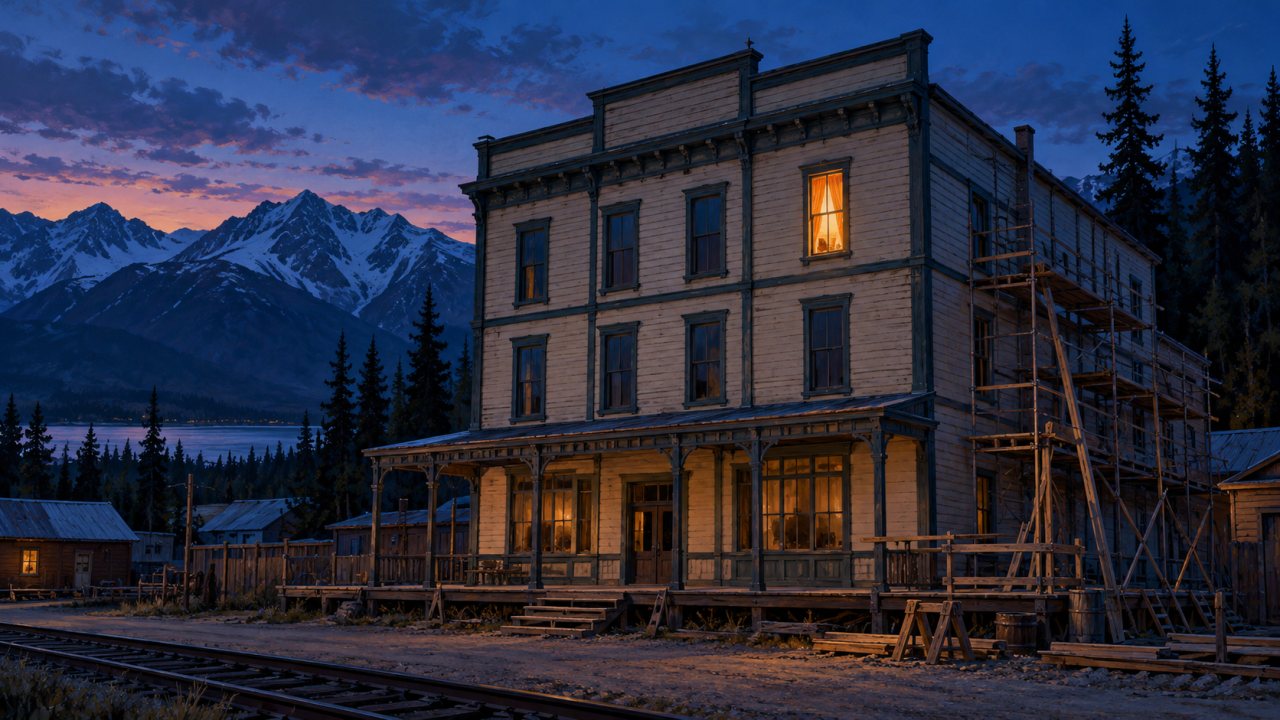
Editorial illustration, not documentary imagery.
When a couple purchased a deteriorating historic hotel in Canada's Yukon Territory, they expected years of difficult renovations. What they did not expect were reports of illuminated windows in a building without electricity, footsteps approaching workers on empty staircases, mysterious camera malfunctions, and sightings of a long-dead hotelkeeper. The property's documented history includes a Gold Rush, a devastating fire, an eccentric parrot, and the violent death of a former owner.
Lights Appear in a Hotel Without Electricity
In 2006, Anne Morgan and her partner, building contractor Jamie Toole, purchased the Caribou Hotel in Carcross, Yukon.
The three-story wooden building had stood in the small northern community since 1910, but decades of deterioration had left it in poor condition.
The couple intended to restore the hotel to its original appearance and eventually reopen it as a bed-and-breakfast.
They soon began hearing unusual stories from local residents.
According to Morgan, people occasionally reminded the new owners to turn off the lights on the hotel's third floor.
There was one significant problem with those requests.
The building had not yet been connected to the local electrical utility.
Morgan described these incidents in an October 31, 2019, interview with construction journalist Peter Kenter, published in Daily Commercial News.
She and Toole had not known about the hotel's haunted reputation when they bought it.
As restoration progressed, they learned that previous owners, employees, and visitors had reported unusual activity inside the building for years.
The supposed source was a woman who had died more than seven decades earlier.
A Gold Rush Hotel That Crossed a Lake
The Caribou Hotel's history began during the Klondike Gold Rush of the late 1890s.
In 1898, a hotel was established in Bennett, British Columbia, a major staging point for prospectors traveling toward the Yukon goldfields.
As the Gold Rush declined, buildings and businesses were relocated from settlements that had lost much of their population.
In 1901, hotelier W. A. Anderson transported his building across Lake Bennett on a scow, a flat-bottomed vessel commonly used to carry cargo.
The building was reestablished in Caribou Crossing, later renamed Carcross.
In 1903, Dawson Charlie, also known as Káa Goox, purchased the hotel.
Dawson Charlie was a member of the Carcross/Tagish First Nation and one of the men credited with discovering gold that helped trigger the Klondike Gold Rush.
He renovated the property and renamed it the Caribou Hotel.
Following his death in 1908, the hotel was leased to Edwin and Bessie Gideon.
Their ownership would become central to the hotel's supernatural reputation.
The Christmas Eve Fire of 1909
On December 24, 1909, a fire swept through central Carcross.
The original Caribou Hotel burned to the ground, along with a neighboring store and the nearby White Pass & Yukon Route railway depot.
The Gideons decided to rebuild.
Using materials salvaged from another building in the former mining community of Conrad, they constructed a new three-story hotel on the same site.
The replacement opened in 1910.
This is the building that survives today.
Contemporary newspaper accounts described the rebuilt hotel as an impressive structure containing 22 bedrooms, a dining room, a billiard room, a parlor, and modern conveniences for the period.
The building quickly became an important gathering place for travelers, miners, hunters, railway passengers, and local residents.
During the construction of the Alaska Highway in the 1940s, the hotel accommodated military personnel and civilian construction workers.
The Gideons helped establish its reputation as a landmark of Yukon hospitality.
After Bessie's death in 1933, however, another reputation began developing.
The Ghost of Bessie Gideon
Bessie Gideon died on October 27, 1933.
Local tradition maintains that she never entirely left the Caribou Hotel.
Her supposed apparition is most frequently associated with the third floor.
Former guests and employees have reported seeing a woman sitting on beds, only for her to vanish moments later.
Others have described doors slamming, footsteps crossing empty rooms, and knocking sounds coming from floors or walls.
One particularly unusual story involves bathwater.
According to the hotel's owners, clear water has reportedly begun producing bubbles without an obvious explanation, as though soap had suddenly been added.
People walking outside have also claimed to see a woman resembling Bessie standing near an upstairs window.
Some versions of the story describe a parrot accompanying her.
The hotel's official website embraces the legend, describing Bessie as a shy presence who continues watching over the building.
However, the published accounts do not include independently verified photographs, recordings, or other physical evidence demonstrating that the apparition exists.
The figure is identified as Bessie because of the property's history and associated folklore, not because her identity has been scientifically established.
Polly: The Hotel's Unusual Resident
The parrot associated with Bessie's ghost was a real animal.
Polly arrived at the Caribou Hotel in 1918 after Captain James Alexander, a mining figure, asked the Gideons to care for the bird while he traveled.
Alexander and his wife subsequently died in the sinking of the Princess Sophia, a passenger steamship lost in Alaska waters in October 1918.
Polly remained at the hotel.
Despite the name, Polly was male.
Over the following decades, he became a local celebrity, known for singing songs, imitating people, drinking liquor, and using profanity.
Historical accounts identify two songs in particular: I Love You Truly and Springtime in the Rockies.
Polly remained at the Caribou Hotel until his death in 1972.
He was buried in Carcross Cemetery.
The bird's unusual history eventually became intertwined with stories about Bessie's ghost.
Some witnesses reported seeing the former hotelkeeper standing at a third-floor window with what appeared to be her parrot.
There is no independent documentation verifying those sightings.
The actual relationship between Bessie and Polly, however, is well established in the hotel's history.
A Murder Inside the Hotel in 2004
Long after Bessie's death, the Caribou Hotel became the scene of a documented violent crime.
In the early hours of December 24, 2004, hotel owner Robert Olson was severely beaten inside the property.
According to court records, Dean Boucher and Mark Lange had been drinking with Olson when a confrontation developed.
The two men assaulted the hotelkeeper and placed him in the back of his own pickup truck.
They drove toward Whitehorse.
Olson died from his injuries, and his body was abandoned in a snow-covered ditch near the Wolf Creek subdivision.
Police subsequently identified and arrested the two men.
Both were convicted of second-degree murder in 2006.
However, those convictions were overturned on appeal in 2011 because of legal problems affecting the original proceedings.
The men subsequently pleaded guilty to manslaughter.
In February 2012, Boucher received a 12-year sentence, while Lange received nine years and four months.
The murder was followed by the hotel's closure and eventual sale.
Morgan and Toole purchased it in 2006.
The killing added another disturbing chapter to the building's history, although the hotel's ghost stories had already been associated with Bessie for decades.
There is no established evidence connecting Olson's death to the reported paranormal incidents.
The Renovation Crew Encounters Unexplained Activity
When Morgan and Toole began restoring the building, the hotel required extensive structural work.
The deterioration was severe.
According to the Yukon Register of Historic Places, the original foundation was effectively gone.
A single unsupported beam was carrying a significant portion of the building's weight.
There was approximately half a metre of height difference between the front and rear of the structure.
Some walls and floors were so deteriorated that Toole could push his hand through them.
The building had to be substantially gutted to reduce its weight before workers could rebuild the rear wall, install a new foundation, and create a basement.
Restoring it required years of careful structural work.
During those renovations, employees reportedly experienced events they could not immediately explain.
One worker described a sudden gust of wind passing through a closed doorway, followed by the sound of footsteps.
Others reported unusual noises inside rooms that appeared empty.
For years, Toole dismissed the supernatural stories.
He considered himself skeptical of ghosts and did not interpret the reported incidents as evidence of paranormal activity.
Then, in 2019, he experienced something that challenged his position.
Footsteps Approach a Contractor on an Empty Staircase
According to Morgan's account, Toole had completed drywall installation on the third floor.
He was preparing to move downstairs and inspect work needed on the second floor.
As he approached the staircase, he heard footsteps coming toward him from below.
The sounds reportedly moved up the stairs in his direction.
Toole believed somebody was approaching.
But nobody appeared.
The footsteps seemed to pass beside him, even though he was alone inside the building.
Disturbed, he left the hotel and immediately called Morgan.
He told her that he had heard somebody climbing the staircase while no one else was present.
Morgan later recounted the encounter to Peter Kenter.
She found Toole's reaction particularly notable because he had previously rejected the other workers' ghost stories.
The incident did not produce an identified apparition or physical evidence.
Nevertheless, Toole reportedly regarded the sounds as unusual enough to abandon his immediate work and leave the building.
It became one of the most significant paranormal accounts associated with the renovation.
Strange Photographs Taken on the Anniversary of Bessie's Death
Morgan also described unexplained camera problems during visits to the property.
On at least one anniversary of Bessie Gideon's death, Morgan and a friend visited the hotel and attempted to take photographs.
According to the 2019 article, their digital camera or phone display began malfunctioning.
They described static-like interference and unusual particles appearing on the screen.
The shapes reportedly seemed to form a human figure.
The witnesses associated the event with the date and the hotel's haunting legend.
However, no independently examined original image file, device diagnostic report, or controlled reproduction of the effect was presented in the published account.
Digital cameras can produce visual artifacts because of sensor noise, low light, software processing, motion, or other technical factors.
Those possibilities do not establish what caused the reported anomaly.
They do mean that an unexplained image cannot be treated as proof of a spirit without further examination.
Could the Renovation Explain Some of the Reports?
Construction inside an old wooden building can produce unusual sounds and movements.
The Caribou Hotel was undergoing major structural repairs while the reported incidents occurred.
Workers were replacing deteriorated materials, leveling the building, altering the foundation, and changing interior spaces.
Those activities can affect how a structure behaves.
Wooden framing expands and contracts with changes in temperature and moisture.
Loose floorboards and staircases can produce sounds resembling footsteps.
Wind can create pressure differences through openings, shafts, and partially completed rooms.
Construction vibrations can travel through framing and become audible far from their source.
The hotel also had serious structural deterioration, creating additional reasons to investigate unfamiliar noises.
These explanations cannot account conclusively for Toole's reported staircase experience because no acoustic measurements or contemporaneous investigation are publicly available.
Similarly, the story of lights appearing on the third floor while the building lacked utility service remains an unverified observation.
The available reporting does not establish whether witnesses were seeing artificial light, reflected light from outside, or another phenomenon.
The accounts are evidence that people reported unusual experiences, not scientific confirmation that paranormal activity occurred.
The Restoration Continues
Despite the hotel's reputation, Morgan and Toole continued their renovation.
By August 2019, the saloon had reopened.
The couple planned to create 11 guest rooms, a restaurant, and additional accommodations while preserving the building's historic character.
The Yukon government officially recognizes the Caribou Hotel as a historic site.
Restoration has continued beyond the period described in Kenter's original article.
A 2024 Yukon government briefing identified financial support for improvements to the 11 hotel rooms, kitchen, restaurant, and saloon.
Later, Tech Yukon documented assistance provided to Morgan for establishing an online booking system and preparing the property for commercial reopening.
The official Caribou Hotel website still describes the main building's restoration as ongoing.
Travel Yukon's current listing identifies the Surly Bird Saloon as operating during summer months and the nearby Chilkoot Cabins as offering year-round accommodation.
These sources confirm that the property remains an active heritage-restoration project, although they do not establish that all 11 historic hotel rooms have reopened.
Is the Caribou Hotel Really Haunted?
The Caribou Hotel has an unusually extensive history for a building of its size.
Its original predecessor was moved across a lake during the Klondike Gold Rush.
The property was destroyed by fire in 1909 and rebuilt in 1910.
It accommodated prospectors, soldiers, construction workers, hunters, and tourists.
A parrot lived there for more than half a century.
A hotel owner was murdered there in 2004.
And during a restoration project beginning in 2006, workers described events that they could not readily explain.
The most widely repeated supernatural legend concerns Bessie Gideon, who died in 1933 and is said to appear near the hotel's third-floor windows.
The 2019 construction account introduced another notable element: a contractor who had dismissed the ghost stories reported hearing approaching footsteps while alone.
That encounter is attributed to a named contractor, but no independent recording establishes its cause.
Likewise, the reports of unexplained lights, moving air, disappearing apparitions, and camera interference remain witness accounts rather than verified paranormal evidence.
The Caribou Hotel's documented history is already extraordinary. Whether Bessie Gideon still wanders its upper floors is the part of the story that remains unproven.
Jude Cassian
Jude Cassian tracks the strange, dark, unexplained, and absurd corners of the world with independent curiosity and no political or religious spin.
Sources
Suggested Articles You Might Enjoy
The Haunted Boiler of Eldon House: A Repairman Encounters Disappearing Shoes Inside Canada's Historic Mansion
A 2005 Eldon House boiler repair led to reports of sudden physical sensations and vanishing shoes. The alleged diary connection remains unverified.
Haunted Homes Under Renovation: St. Louis Contractors Report Ghostly Figures, Moving Doors, and a Serious Ladder Accident
A St. Louis remodeler reported strange figures, lights, a moving attic door, and a serious ladder fall at two homes. Physical explanations remain unruled out.
Red Laser DMT, Alien Glyphs, and Simulation Code
A skeptical look at the viral 650 nm red-laser DMT claim, the reported alien glyphs, and why neuroscience and optics explain more than simulation-code speculation.
Reference
https://canada.constructconnect.com/dcn/news/projects/2019/10/hotel-cari-boo-renovation-of-yukon-landmark-with-supernatural-sightings
Reference
https://register.yukonhistoricplaces.ca/Print/775
Reference
https://yukon.ca/sites/yukon.ca/files/tc/tc-walking-tour-carcross.pdf
Reference
https://www.caribouhotel.ca/pages/history.php
Reference
https://www.travelyukon.com/en/get-inspired/haunted-caribou-hotel
Reference
https://www.explorenorth.com/yukon/carcross-caribou_hotel.html
Reference
https://www.caribouhotel.ca/pages/polly.php
Reference
https://www.yukoncourts.ca/sites/default/files/documents/en/2011ykca7_r_v_lange.pdf
Reference
https://www.whitehorsestar.com/News/hoteliers-killers-say-they-are-changed-men
Reference
https://www.techyukon.ca/our-impact/
Reference
https://www.travelyukon.com/en/see-and-do/experience-providers/caribou-hotel
Reference
https://www.caribouhotel.ca/
Reference
https://open.yukon.ca/information/de20b25e-b7d5-45ed-aacd-5ce4e968bec4/resource/8a5bc46d-69b7-3e35-bde0-56bb46e3150f/download/tc_spring_2024.pdf