
Mystery Animal Attacks Three People in New Hampshire: Police Fear Rabies as Creature Evades Capture
Three people reported attacks by an unidentified animal near Lebanon, New Hampshire. Police suspected a gray fox or fisher, but rabies was never confirmed.
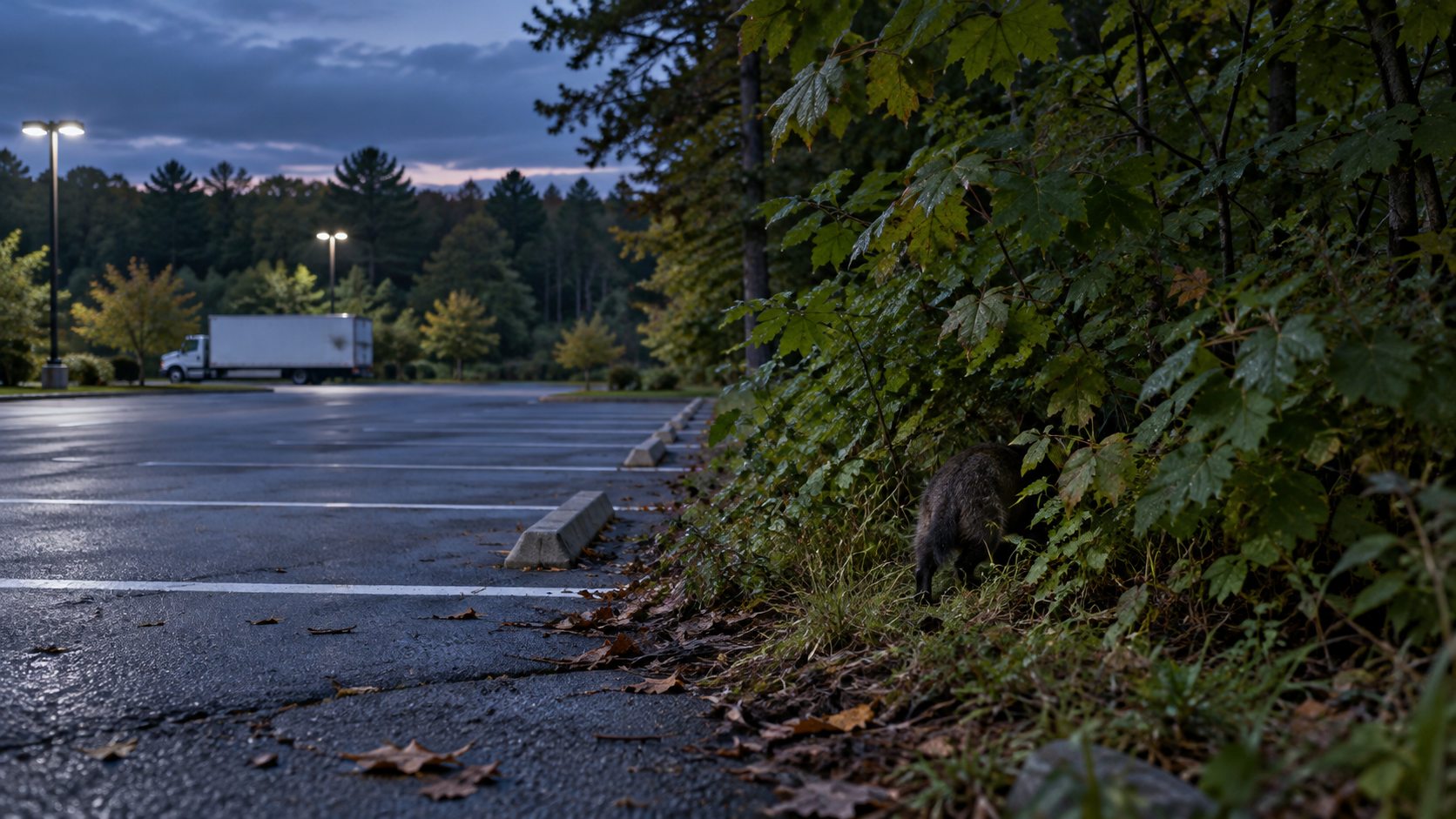
Editorial illustration, not documentary imagery.
In August 2026, a small, unidentified animal began attacking people near a commercial park in Lebanon, New Hampshire. Within approximately 36 hours, three attacks had been reported. Surveillance footage captured the creature repeatedly lunging at a man, grabbing his belongings, and refusing to release his leg. Police suspected a gray fox or fisher, but the animal disappeared before wildlife officials could identify it or determine whether it carried rabies.
A Strange Animal Attacks a Man in a Parking Lot
On August 30, 2026, Zack Howard of Enfield, New Hampshire, parked his U-Haul moving truck outside FitKids ChildCare near Centerra Parkway in Lebanon.
His girlfriend worked at the facility, and Howard believed the parking lot would be a secure place to leave the truck.
As he stepped outside, he felt something nip at his heel.
He looked down and noticed a small animal moving around the vehicle.
Before he could react, the creature rushed toward him.
Security cameras recorded what happened next.
The animal darted around the parking lot, repeatedly approaching Howard despite his attempts to move away.
It grabbed a bag he was carrying and pulled it from him.
When Howard attempted to retrieve the bag, the animal returned and attacked his foot.
It then latched onto his leg.
Howard shook his leg and attempted to drive the animal away, but it refused to release him.
He eventually kicked the animal away.
The creature retreated beneath the truck before running toward nearby vegetation.
Howard's girlfriend came outside during the encounter.
The entire incident was captured on video and subsequently shared by local media outlets.
At first, viewers had difficulty identifying the animal. It appeared approximately the size of a domestic cat, with grayish fur and a long tail.
Its behavior was considerably more unusual than its appearance.
"Dude, Let Go": The Victim Describes the Attack
On September 4, Howard spoke with WMUR News 9 reporter Jon Schoenheider.
He described how the animal repeatedly returned to attack him even after being driven away.
Howard believed the animal was a fox.
He said its tail and orange-colored underside made the identification seem obvious to him.
He also recalled speaking directly to the animal while trying to free his leg.
"Dude, let go," he remembered saying.
Howard said he did not want to kick the creature, but eventually felt he had no alternative.
The animal's teeth punctured his running shoe, although the attack reportedly did not draw blood.
Because the animal's health status was unknown and rabies was a concern, Howard received preventive rabies treatment.
He later joked that the injections in his foot were more painful than the encounter itself.
The incident ended without a reported serious physical injury, but the animal's refusal to retreat raised immediate concerns.
Wild animals generally avoid confrontations with people when escape is possible.
This creature appeared to do the opposite.
Two More Attacks Are Reported
The encounter involving Howard was not an isolated incident.
On August 31, the Lebanon Police Department issued a public warning about an apparent unprovoked animal attack near Centerra Parkway.
The department initially described the suspected animal as a fisher, commonly called a fisher cat.
By September 1, police had received reports of two additional attacks in the same general area.
The third incident had occurred the previous evening.
Authorities believed the same animal might have been responsible for all three.
Witnesses described a small, unusually aggressive creature that appeared to be either a gray fox or a fisher.
The police department confirmed that officers had not personally encountered the animal and could not establish its species.
Its behavior was the principal concern.
Rather than fleeing when confronted by people, the animal reportedly approached and attempted to scratch or bite them.
Lebanon Police Chief Phillip Roberts told WMUR that the aggression suggested something might be wrong with the animal.
Rabies was among the possibilities being investigated.
Police Search the Woods With a Drone
The Lebanon Police Department contacted the New Hampshire Fish and Game Department.
Officers searched the wooded and brush-covered areas surrounding Centerra Park.
According to WCAX, police also used a drone equipped with thermal imaging capabilities to look for the animal.
The search did not locate it.
The wooded areas around Centerra Parkway presented a challenge.
A relatively small animal could disappear beneath shrubs, move through dense vegetation, or travel along the edges of the commercial development without being readily visible.
Police encouraged residents, workers, and visitors to avoid approaching unusual wildlife.
They also requested reports of additional sightings.
The goal was to locate the animal, determine its species, and evaluate whether it was ill.
If officials could safely recover the animal, appropriate laboratory examination could potentially determine whether it was infected with rabies.
Without the animal, however, the investigation remained dependent on witness descriptions and surveillance footage.
Was It a Gray Fox or a Fisher Cat?
The two leading possibilities were both native North American mammals.
However, they are biologically different animals.
Gray Fox
The gray fox, Urocyon cinereoargenteus, is a small wild canine found in parts of New Hampshire.
It typically has gray, black, and reddish fur, a bushy tail with a dark stripe, and a relatively compact body.
Gray foxes can climb trees, a capability unusual among members of the dog family.
They generally avoid humans.
Like other wild mammals, foxes can contract rabies.
Howard's description of a gray animal with an orange underside and noticeable tail was consistent with some characteristics of a gray fox.
That resemblance was not enough to confirm the identification.
Fisher
The fisher, Pekania pennanti, belongs to the weasel family rather than the cat family.
It has an elongated body, relatively short legs, dark brown fur, and a thick tail.
Fishers are agile predators that hunt small mammals, birds, and even porcupines.
They usually avoid people and are rarely involved in unprovoked attacks.
Although the animal in the parking-lot video appeared small enough to resemble either candidate, investigators said the footage was insufficient to make a definitive identification.
The uncertainty persisted because officials had not recovered the animal.
Could Rabies Explain the Strange Behavior?
Rabies became an immediate concern because the animal reportedly attacked several people without an obvious provocation.
Rabies is a viral disease that affects the central nervous system of mammals.
Infected animals may develop neurological problems, including abnormal aggression, disorientation, loss of coordination, paralysis, and changes in normal behavior.
Some become unusually bold around people.
Others become quiet, weak, or lethargic.
A normally cautious wild animal repeatedly attacking people could therefore raise legitimate suspicion of rabies.
However, aggression alone does not prove infection.
An animal may behave defensively because of injury, fear, territorial circumstances, or another illness.
Police could not diagnose the animal from a video.
Rabies confirmation generally requires laboratory examination of appropriate tissue from the suspect animal.
Because the creature was not recovered, no confirmed diagnosis was established.
For Howard and the other people involved, that uncertainty made medical assessment important.
Why Doctors Treat Possible Rabies Exposure Immediately
Rabies is among the most serious infections transmitted by animals.
The virus generally spreads through infected saliva entering the body through a bite, broken skin, or contact with certain mucous membranes.
Once clinical symptoms develop, the disease is almost always fatal.
However, post-exposure prophylaxis can prevent rabies when appropriately administered before symptoms begin.
Treatment may include wound cleaning, rabies vaccine, and, for some patients, rabies immune globulin.
Whether treatment is necessary depends on the nature of the exposure, the animal involved, vaccination history, and medical evaluation.
The Centers for Disease Control and Prevention recommends thoroughly washing possible exposure wounds with soap and water for 15 minutes and seeking prompt medical advice.
A small bite should not be ignored merely because it appears minor.
At the same time, touching an animal's belongings or seeing it nearby is not itself proof of rabies exposure.
In Howard's case, he underwent preventive treatment because of the circumstances of the encounter and uncertainty about the animal.
There was no public report establishing that he developed rabies.
Another Fox Attack Occurs Elsewhere in New Hampshire
The Lebanon incidents were followed by another unusual wildlife encounter in a different New Hampshire community.
On September 5, 2026, police in Marlborough responded after a gray fox reportedly attacked two people near Route 12.
According to WMUR, the animal also attacked parts of stopped vehicles, including tires and bumpers.
Officers euthanized the fox and arranged for testing.
Marlborough is approximately an hour's drive from Lebanon.
The timing attracted attention because the two incidents involved unusually aggressive wildlife within days of each other.
However, they were separate investigations.
There is no verified evidence that the Marlborough fox was responsible for the Lebanon attacks.
The animals should not be treated as the same creature, and the available reporting did not establish that the two incidents shared a common cause.
The Marlborough encounter does illustrate why authorities take repeated, apparently unprovoked attacks by wild mammals seriously.
What Happened to the Mystery Animal?
By September 6, 2026, investigators still had not confirmed the identity of the animal involved in the Lebanon attacks.
WMUR reported that New Hampshire Fish and Game officials had repeatedly searched the area.
Lieutenant James Kneeland said personnel had been visiting regularly, hoping to encounter the creature and determine what it was.
At that point, no additional attacks had been reported.
The absence of new incidents did not establish what had happened to the animal.
It might have moved away from the area, died, or simply avoided further contact with people.
None of those possibilities was confirmed.
Reports available through October 25, 2026, did not provide a verified announcement that officials had captured the animal, identified its species, or obtained a rabies test result.
Nor was there an official finding establishing that a single animal was responsible for every reported attack.
Police considered that explanation likely based on the similar incidents occurring close together.
The animal's identity ultimately remained unconfirmed in the available public record.
A Small Animal Creates a Major Public Safety Scare
The Lebanon incident received widespread attention because surveillance cameras recorded an encounter that was both unusual and disturbing.
The animal was not particularly large.
It was reportedly around the size of a house cat.
Yet it repeatedly approached a much larger person, seized an object he was holding, and latched onto his leg despite efforts to drive it away.
Within approximately 36 hours, police received three reports of similar attacks.
Residents became more cautious around nearby wooded areas, while wildlife officials attempted to locate the animal.
The investigation was complicated by the creature's uncertain identity and the possibility of rabies.
The final outcome remains unclear.
The animal was not positively identified in the available reporting, and no laboratory result established whether it was infected.
The most unsettling detail is that the creature was ordinary-looking enough to resemble a fox or fisher, yet behaved in a way that caused wildlife authorities to suspect a potentially fatal neurological disease.
Three reported attacks, a widely circulated surveillance video, and a multiagency search left New Hampshire residents with a basic unanswered question:
What exactly was attacking people near Centerra Parkway?

Jude Cassian
Jude Cassian tracks the strange, dark, unexplained, and absurd corners of the world with independent curiosity and no political or religious spin.
Sources
Suggested Articles You Might Enjoy
The Enfield Horror: A Three-Legged Monster, Six-Toed Footprints, and the Illinois Town That Became a Cryptid Mystery
In 1973, an Illinois man reported a three-legged creature outside his home. A later sociological study examined how the Enfield Horror became an enduring cryptid legend.
An Eight-Foot Monster Lizard Took Over a Florida Family's Backyard and Evaded Capture for Months
Bamboo, an escaped eight-foot Asian water monitor, spent more than two months loose around homes in Davie, Florida, before wildlife officers captured it.
Rabid Raccoons Return to Los Angeles After 53 Years: Two Test Positive, Six Workers Get Exposure Follow-Up
Two rabies-positive raccoons appeared in Westlake Village within weeks. Six workers were referred for exposure follow-up as officials investigate a bat-linked variant.
Reference
https://www.hindustantimes.com/trending/us/mystery-animal-terrorizes-new-hampshire-neighborhood-attacks-3-people-in-2-days-watch-scary-video-101788492394607.html
Reference
https://lebanonnh.gov/m/newsflash/Home/Detail/6438
Reference
https://lebanonnh.gov/m/newsflash/Home/Detail/6440
Reference
https://www.wmur.com/article/aggressive-animal-attack-lebanon-9126/73584980
Reference
https://www.wmur.com/article/new-hampshire-animal-attack-viral-video-9426/73618652
Reference
https://www.wcax.com/2026/09/02/police-search-animal-involved-3-attacks-lebanon/
Reference
https://www.wcax.com/2026/09/02/lebanon-shoppers-alert-after-suspected-rabid-animal-attacks/
Reference
https://www.livenowfox.com/news/watch-mystery-animal-new-hampshire
Reference
https://www.wmur.com/article/fox-attack-marlborough/73634697
Reference
https://www.maine.gov/ifw/fish-wildlife/wildlife/species-information/mammals/fisher.html
Reference
https://www.maine.gov/ifw/fish-wildlife/wildlife/species-information/mammals/foxes.html
Reference
https://www.cdc.gov/rabies/when-to-seek-care/
Reference
https://www.cdc.gov/rabies/hcp/clinical-care/post-exposure-prophylaxis.html