
The Beanbag Adventure Mystery: Did a Chinese Explorer Discover a Pool of Human Bodies Beneath an Abandoned Hospital?
A 2022 urbex video showed human-shaped objects in a basement pool. A 2026 lead points to a former Changchun hospital, but neither the site nor the objects have been verified.
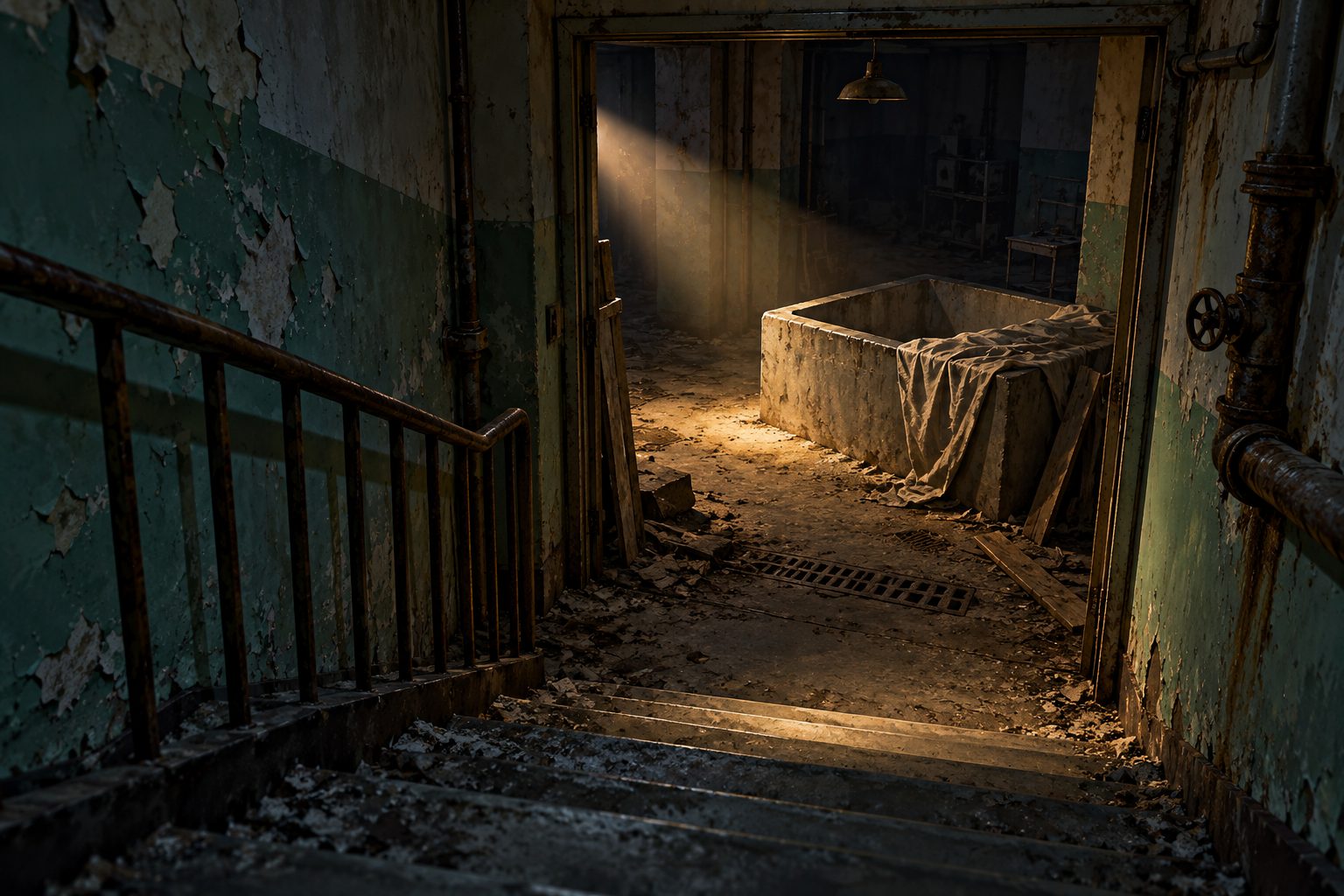
Editorial illustration, not documentary imagery.
In 2022, a Chinese urban explorer entered an abandoned building and filmed something that disturbed viewers around the world: a dark underground chamber containing a concrete pool filled with what appeared to be decomposing human remains. Some figures resembled children. Nearby were bottles, bones, and other objects that suggested a possible medical connection. The footage disappeared from the creator's original account, triggering allegations of illegal organ harvesting and a cover-up. Four years later, online investigators may finally have identified the building.
A Disturbing Discovery Beneath an Abandoned Building
In 2022, a Chinese urban explorer using the name Beanbag Adventure began posting videos of an abandoned building on Douyin, China's domestic counterpart to TikTok.
The account, known in Chinese as 豆包探险 (Doubao Tanxian), primarily featured explorations of deserted buildings and other forgotten locations.
The videos initially showed a deteriorating institutional structure surrounded by vegetation.
Inside were dark corridors, abandoned rooms, and scattered objects.
The explorer eventually descended into an underground area that resembled a former air-raid shelter or basement laboratory.
There, he discovered a large concrete basin containing dark liquid.
Inside the basin were numerous human-shaped objects.
Some appeared to have the proportions of infants or young children. Others were partially obscured by the liquid and debris.
The explorer repeatedly reacted to an overwhelming smell.
He told viewers that the objects were props left behind after a film production.
However, their appearance prompted immediate skepticism.
Some viewers believed they resembled actual human remains undergoing decomposition.
Others argued that realistic props could have been deliberately arranged to create a shocking video.
Neither explanation was independently verified.
A Second Visit Raises More Questions
One of the most significant details was that Beanbag returned to the location.
During a video dated December 26, 2022, the explorer entered the underground chamber again.
He displayed the date and time on his phone while filming.
The concrete basin was still present.
This time, portions of it appeared covered by wooden boards and a tarpaulin.
Bottles, tubing, and other discarded objects were visible around the room.
Viewers examining the recordings claimed that some human-shaped figures appeared more deteriorated than in the earlier footage.
Several observers also believed the liquid level had changed.
Those apparent differences became central to the online debate.
If the figures were artificial props, why did they seem to change over time?
Could exposure to water, dirt, and environmental conditions explain their appearance?
Or were viewers observing the deterioration of actual biological material?
The footage did not answer those questions.
No laboratory examination of the objects was documented, and the original recording dates were not independently authenticated through unedited metadata.
Nevertheless, the return visit made the story substantially more difficult for internet audiences to dismiss.
Bottles, Bones, and a Possible Anatomical Collection
Additional footage from the location showed objects that viewers interpreted as medical specimens.
These reportedly included a jar containing a fetus-like figure, loose bones, and other skeletal material.
Some appeared to be stored in bags or grouped together.
Commentators speculated that the facility had once been used for anatomical education, tissue preservation, or medical research.
The objects resembled materials that might be encountered in a medical teaching collection.
But visual resemblance is not scientific identification.
Anatomical teaching models can be manufactured from plastics, silicone, resin, and other materials.
Artificial skeletal specimens are also widely used in medical education.
Without physical examination, researchers cannot establish from online footage alone whether a particular object is biological or artificial.
The presence of bottles and apparent skeletal material therefore suggests a possible medical context but does not prove the existence of a clandestine laboratory.
How the Videos Spread Beyond China
The footage began attracting attention outside China in early 2023.
On January 14, clips appeared on X, formerly Twitter.
By January 18, users on Reddit were circulating the videos and speculating about their location.
On February 28, 2023, YouTube creator Nick Crowley published an investigation exploring the footage and competing explanations.
His video introduced the story to a much larger English-speaking audience.
On March 1, internet-culture publication Know Your Meme published an article documenting the videos and their spread.
By then, the mysterious basement was being described in increasingly dramatic terms.
Some called it a secret organ-harvesting facility.
Others suggested a serial killer's dumping ground.
Another explanation involved abandoned anatomical specimens from a medical institution.
The theories expanded considerably beyond what the actual footage could establish.
The original videos were also removed from Beanbag Adventure's Douyin account.
For some viewers, their disappearance suggested censorship or an organized cover-up.
However, the account subsequently reappeared, and the creator reportedly resumed posting ordinary urban-exploration content.
There is no verified evidence that the explorer was arrested, killed, or forcibly disappeared because of the videos.
Removal of disturbing material from a social media platform does not, by itself, establish government interference.
The December 2023 Reddit Investigation
On December 9, 2023, a Reddit user named conereport published the first installment of a three-part investigation in r/NoRules.
The series examined the videos and proposed a different explanation from the widely circulated organ-harvesting theory.
The author suggested that the underground space may have been used to process or preserve human bodies intended for anatomical education or exhibition.
The theory relied on several observations.
The objects appeared to be submerged in liquid.
Some remained recognizable despite their apparent deterioration.
The surrounding rooms contained materials resembling medical or anatomical equipment.
The author also noted that organ transplantation requires organs to remain medically viable.
Storing bodies for extended periods in chemical preservatives would not be compatible with preserving organs for transplantation.
Instead, the author proposed that the facility might have been associated with preservation, specimen production, or the processing of remains.
The investigation devoted considerable attention to plastination, a technique used to preserve anatomical specimens.
However, the Reddit series did not establish that the building was actually used for plastination.
It did not identify any person whose remains were supposedly present.
Nor did it provide verified records linking the property to a commercial anatomical specimen operation.
The argument remained a hypothesis based on visual interpretation and research into the wider anatomical specimen industry.
What Is Plastination, and Could It Explain the Scene?
Plastination is a real scientific process developed by anatomist Gunther von Hagens in the late 1970s.
It is used to preserve biological specimens for medical education, research, and public exhibitions.
The International Society for Plastination explains that the process replaces water and fats inside tissues with polymers that harden.
The resulting specimens can be preserved for extended periods without the same type of decomposition seen in untreated tissue.
Plastination generally involves fixation, dehydration, polymer impregnation, and curing.
Preserved human specimens are sometimes displayed in anatomical exhibitions.
However, there is no evidence that the material in Beanbag's videos had undergone plastination.
The underground basin also would not, by itself, demonstrate that the facility was producing plastinated specimens.
A separate possibility is that the liquid was intended for conventional anatomical preservation.
Formalin, a solution containing formaldehyde, is widely used in pathology and anatomical laboratories.
A technical clarification is important here.
Commercial concentrated formalin generally contains approximately 37–40% formaldehyde.
The commonly used laboratory preparation known as 10% neutral buffered formalin contains approximately 3.7–4% formaldehyde.
Some online discussions incorrectly treat those concentrations as interchangeable.
No chemical sample from the underground basin has been tested publicly.
Consequently, the claim that its contents were submerged in formalin remains unverified.
Why "Corpse Farm" May Be the Wrong Description
The phrase corpse farm became popular during discussions of the videos.
However, legitimate forensic research facilities commonly called body farms are quite different from the operation imagined by internet commentators.
At the University of Tennessee in Knoxville, the Anthropology Research Facility uses donated human remains to study decomposition.
The findings help forensic scientists estimate the time since death and improve methods of recovering human remains.
Other universities operate similar research facilities.
These programs generally use documented donations and conduct research under established institutional procedures.
A clandestine operation manufacturing anatomical specimens, if one existed, would not be equivalent to a legitimate forensic body farm.
The terms became confused in Reddit discussions because participants were considering several different possibilities: anatomical preservation, illegal body trafficking, medical education, and criminal disposal of remains.
Those are separate activities with very different purposes.
None has been established as the explanation for Beanbag's footage.
A New Lead Emerges in September 2026
For years, one of the biggest obstacles was the unidentified location.
Early speculation placed the facility in China's Jilin Province, particularly around Changchun.
Some commenters suggested an underground structure connected to the Bethune Medical College of Jilin University.
Others proposed entirely different locations, including Vietnam.
No convincing identification emerged from those early discussions.
Then, on September 13, 2026, a Reddit user named Due-Concentrate3961 published a new investigation in r/InternetMysteries.
The user proposed that Beanbag's footage had been filmed at the former Jilin Diesel Engine Factory Workers' Hospital, located on Rongguang Road in Changchun.
The proposed Chinese name was 吉林柴油机厂职工医院.
The investigator compared exterior features visible in Beanbag's recordings with historical Baidu Maps imagery.
Several details appeared to match:
- A yellow two-story institutional facade.
- Projecting roof gables.
- Small diamond-shaped ventilation openings.
- A distinctive arrangement of windows.
- A red entrance canopy.
The researcher argued that the resemblance was too specific to overlook.
The discovery gained attention because it provided something earlier theories lacked: a named institution and a possible address that could be checked against historical records.
Historical Directories Confirm the Hospital Existed
An independent search of Chinese medical directories confirms that a hospital with this name existed.
The institution is listed as the Shougang Jilin Diesel Engine Factory Workers' Hospital.
Its recorded address was 42 Rongguang Road, Erdao District, Changchun, Jilin Province.
A Chinese medical reference lists it as a general hospital.
Another hospital directory identifies the same address and associates the institution with the name Jilin Huakang Geriatric Hospital.
These records support the existence and historical medical function of the facility.
They do not establish that the specific building shown in Beanbag's videos belonged to that hospital.
Nor do they prove that the basement was used to store anatomical specimens.
The Reddit researcher suggested that the hospital dated to approximately 1950 and appeared abandoned in 2019 street-level imagery.
Those details require additional archival confirmation.
Nevertheless, the discovery represents one of the more concrete location leads produced since the videos first circulated.
If the building identification is correct, it would make a former medical facility a substantially more plausible setting than an unidentified underground criminal laboratory.
Could the Objects Have Been Abandoned Medical Specimens?
The possible hospital connection gives rise to a comparatively straightforward theory.
Perhaps the basement contained anatomical specimens left behind when the institution stopped operating.
Hospitals and medical teaching facilities sometimes maintain collections of preserved organs, bones, and other biological specimens.
Such collections require appropriate documentation, storage, maintenance, and disposal procedures.
If a medical institution closed or transferred operations, improperly abandoned specimens could eventually become a serious public-health and ethical concern.
However, several facts would need to be established before applying that explanation to the videos.
Investigators would need to confirm that the objects were biological remains.
They would also need to establish the hospital's connection to the underground area, determine when the materials were placed there, and identify the institution or individuals responsible.
The public record currently provides none of those answers.
Even the presence of a real former hospital would not establish whether the material was legally acquired, improperly discarded, or artificially created.
The abandoned-specimen explanation is plausible, but it remains unproven.
What About the Organ-Harvesting Allegations?
The most sensational interpretation is that the facility was connected to illegal organ harvesting.
That allegation spread widely because some viewers believed the objects showed opened body cavities or missing internal organs.
However, there are major evidentiary problems with the theory.
There is no independently verified identification of human remains in the videos.
There is no authenticated evidence establishing how any possible remains arrived at the property.
There is no documentation linking the location to transplant operations.
And there is no confirmed criminal investigation demonstrating that organs were removed there.
The broader international controversy surrounding the sourcing of human specimens and allegations of organ trafficking cannot establish what happened at a particular building.
Historical disputes concerning anatomical exhibitions are real, but they cannot substitute for evidence connecting the Beanbag location to those activities.
The same limitation applies to theories involving missing children, murder victims, or government-directed experimentation.
None is supported by case-specific forensic evidence.
The Mystery of the Deleted Videos
Another persistent question concerns what happened to Beanbag Adventure's original recordings.
The most disturbing videos disappeared from the Douyin account.
Copies survived because other users had downloaded and redistributed them.
Some commenters interpreted their removal as evidence of censorship.
Others suggested the videos violated platform rules concerning graphic content.
The creator himself had initially described the figures as film props.
That explanation could have been truthful, mistaken, or intended to reduce controversy.
The available evidence cannot establish his motivation.
Importantly, the disappearance of the videos should not be confused with the disappearance of their creator.
Contemporary internet documentation indicates that his account returned and continued posting content.
There is no verified record demonstrating that the explorer was detained because of the basement footage.
The digital trail has therefore produced more speculation than concrete answers.
Four Years Later, What Has Actually Been Proven?
By October 2026, several parts of the story are documented.
A Chinese urban-exploration account published videos of an abandoned facility containing disturbing human-shaped objects.
The footage circulated internationally during 2022 and 2023.
The creator returned to the location and filmed additional material.
The original videos disappeared from his account, but copies remained online.
In September 2026, an independent internet researcher identified a plausible former hospital that appeared to match the filmed exterior.
Chinese historical medical directories confirm that the proposed hospital was a real institution in Changchun.
But the most important questions remain unresolved.
No publicly authenticated forensic examination establishes whether the figures were human bodies or realistic artificial specimens.
No verified identification establishes the age, sex, or identity of any possible deceased individuals.
No documented investigation confirms that organ harvesting, murder, or illegal specimen production occurred at the site.
And the proposed hospital location has not been conclusively authenticated.
The disturbing possibility is that an urban explorer may have discovered abandoned human anatomical remains inside a forgotten medical facility. The equally important fact is that the available evidence still cannot rule out artificial props or another explanation.
For now, Beanbag Adventure remains an internet mystery built around widely circulated footage, disputed visual evidence, and an increasingly specific—but still unconfirmed—location.
The 2026 hospital lead may eventually help establish what the building was.
It has not yet established what was inside the pool.

Jude Cassian
Jude Cassian tracks the strange, dark, unexplained, and absurd corners of the world with independent curiosity and no political or religious spin.
Sources
Suggested Articles You Might Enjoy
The Enfield Horror: A Three-Legged Monster, Six-Toed Footprints, and the Illinois Town That Became a Cryptid Mystery
In 1973, an Illinois man reported a three-legged creature outside his home. A later sociological study examined how the Enfield Horror became an enduring cryptid legend.
The Devil House of Bolivia: A Home Covered in Demons Terrifies Neighbors, but Its Owner Says They Protect Him
David Choque covered his El Alto home with horned sculptures tied to Andean mining traditions. Neighbors feared occult activity, but the allegations were never substantiated.
An Eight-Foot Monster Lizard Took Over a Florida Family's Backyard and Evaded Capture for Months
Bamboo, an escaped eight-foot Asian water monitor, spent more than two months loose around homes in Davie, Florida, before wildlife officers captured it.
Reference
https://www.reddit.com/r/NoRules/comments/18e4bho/bean_bag_adventure_possible_corpse_farm_in_china/
Reference
https://www.reddit.com/r/NoRules/comments/18euw1v/bean_bag_adventure_possible_corpse_farm_in_china/
Reference
https://www.reddit.com/r/NoRules/comments/18g8u13/bean_bag_adventure_possible_corpse_farm_in_china/
Reference
https://knowyourmeme.com/editorials/guides/did-beanbag-adventure-discover-an-organ-harvesting-lab-in-china-the-disturbing-tiktok-videos-explained
Reference
https://knowyourmeme.com/memes/people/beanbag-adventure
Reference
https://www.dexerto.com/entertainment/who-is-beanbag-adventures-chinese-lab-videos-terrify-tiktok-users-but-is-it-real-2074718/
Reference
https://www.reddit.com/r/InternetMysteries/comments/1wfgm3j/i_think_i_might_have_found_the_abandoned_hospital/
Reference
https://www.yixue.com/首钢吉林柴油机厂职工医院
Reference
https://policy.taikang.com/service/hospital_search2/00057545/
Reference
https://plastination.org/isp/about.html
Reference
https://pathbio.med.upenn.edu/pbr/portal/hist/fixation.php
Reference
https://fac.utk.edu/about/
Reference
https://www.cdc.gov/niosh/reproductive-health/prevention/formaldehyde.html
Reference
https://www.mill-milk.com/videos/03bjkPghsPY/