
Are UFOs Demonic? Why Some Christians See UAPs as a Spiritual Deception
Some Christians interpret UAP encounters as spiritual deception rather than extraterrestrial visitation. Here is how that theory works, and what evidence does and does not show.
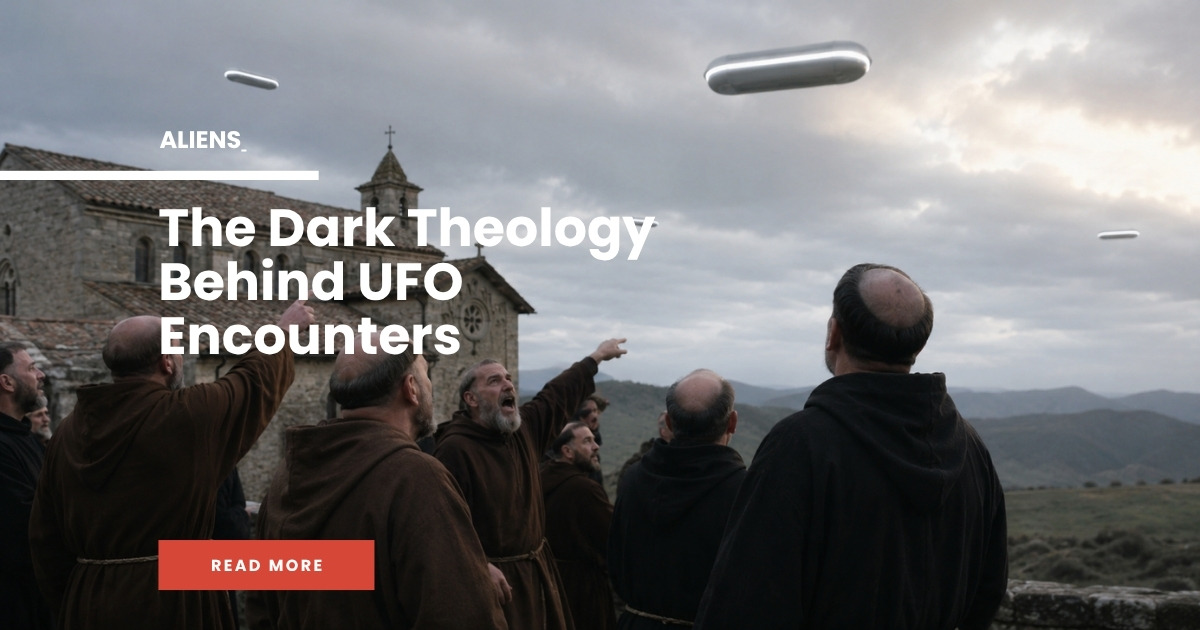
Unidentified Anomalous Phenomena are often discussed as an aerospace mystery. Military pilots report unusual objects, government agencies examine sensor data, and researchers debate whether particular incidents involve balloons, drones, atmospheric effects, classified technology, or something not yet understood.
For some religious communities, however, the central question is not where UAPs come from. It is what they want humanity to believe.
A segment of evangelical and Orthodox Christian thought interprets at least some UFO encounters, alleged abductions, and “alien” communications as deceptive spiritual manifestations. Under this theory, the entities are not biological visitors traveling across interstellar space. They are nonhuman intelligences presenting themselves in a technologically convincing form suited to the modern world.
The proposed objective is theological deception: weaken confidence in biblical revelation, replace God with advanced beings, and persuade humanity that religion was created by extraterrestrials.
The Biblical Framework Behind the Theory
Supporters of the demonic interpretation begin with the biblical claim that human beings inhabit both a visible and an invisible creation. Scripture describes angels, rebellious spiritual powers, demons, and other nonhuman beings capable of influencing human affairs.
The New Testament also repeatedly warns about deception. Second Corinthians describes Satan disguising himself as “an angel of light.” Matthew warns of false signs powerful enough to deceive people. Ephesians describes conflict against “principalities,” “powers,” and “spiritual forces of evil.”
Within this framework, an impressive appearance is not proof of divine or extraterrestrial authority. A brilliant object, apparently supernatural entity, or technologically advanced message could still be deceptive.
The theory therefore focuses heavily on alleged contact experiences in which beings deliver religious or philosophical messages. Some contactees have claimed that extraterrestrials created humanity, engineered biblical miracles, guided ancient civilizations, or sent major religious figures to Earth. For conservative Christians, these narratives do more than propose life on other planets. They reinterpret God, creation, Jesus Christ, and salvation through an extraterrestrial framework.
That is why proponents describe the phenomenon as theological subversion rather than space exploration.
Michael Heiser’s More Careful Position
Michael Heiser, a biblical scholar with a doctorate in Hebrew Bible and Semitic languages, examined UFO beliefs alongside ancient religious texts and Christian demonology. His position was more qualified than the claim that every UFO is demonic.
Heiser argued that genuine biological beings from another planet would not automatically contradict Christianity. Such creatures would simply represent another part of creation. In his analysis, physical extraterrestrials subject to ordinary biological needs would not fit the biblical category of demons.
He nevertheless considered some reported abduction experiences and contactee messages potentially sinister. He wrote that “demonization” was a strong possible explanation for certain phenomena, particularly experiences involving trauma, coercion, occult themes, and religious messaging. He also argued that if alleged entities were interdimensional rather than biological space travelers, the comparison with biblical spiritual beings became more plausible.
Heiser’s distinction is important. The demonic theory does not logically require believers to deny the possibility of extraterrestrial life. It instead separates hypothetical organisms elsewhere in the universe from entities allegedly interacting with people through frightening, manipulative, or religious experiences.
The Orthodox Christian Interpretation
Orthodox writer and monk Father Seraphim Rose presented one of the most influential religious versions of the argument in Orthodoxy and the Religion of the Future. Rose placed UFO encounters within a broader pattern of occultism, altered states of consciousness, Eastern spirituality, and emerging alternative religions.
He believed modern UFO experiences resembled older accounts of spiritual deception but appeared in a form adapted to a technological civilization. Previous cultures might have described encounters with spirits, fairies, or demons. Modern witnesses, conditioned by space travel and science fiction, describe advanced beings, spacecraft, and cosmic federations.
Rose’s central concern was not whether every light in the sky was supernatural. It was the possibility that UFO culture was helping construct a new spirituality outside traditional Christianity, one centered on superior beings who would supposedly transform humanity and replace established religious authority.
Religious Resistance Inside the Pentagon
The demonic interpretation has reportedly influenced discussions within the U.S. national-security establishment.
Former Pentagon intelligence official Luis Elizondo has said that some senior officials opposed investigating UAPs because they believed the phenomena were demonic. According to Elizondo, one official questioned whether studying them was spiritually dangerous and suggested that the Bible already explained their nature.
Elizondo has said he did not share that conclusion. His account is relevant because it demonstrates that the theory is not limited to online ministries or independent religious writers. Religious interpretations can affect whether government officials consider UAP research a scientific obligation, a security issue, or an inappropriate investigation into forbidden spiritual territory.
His testimony does not prove that UAPs are demonic. It only documents that some officials reportedly interpreted them that way.
UFO Belief as a Competing Religion
Religious-studies scholar Diana Walsh Pasulka has approached the subject without declaring UAPs to be angels, demons, or extraterrestrials. Her work instead examines how UFO belief operates socially.
Pasulka argues that UFO culture can display characteristics normally associated with religion: transformative encounters, sacred locations, authoritative witnesses, conversion experiences, hidden knowledge, and expectations of a coming revelation. People who believe they have encountered nonhuman intelligence may reorganize their lives around the experience, much as earlier religious converts responded to visions or apparitions.
This academic perspective helps explain why some Christians view the subject as a spiritual competitor. The concern is not simply that people believe spacecraft are visiting Earth. It is that UFO narratives can generate a complete system of origins, morality, prophecy, and salvation.
In its strongest form, the narrative claims that advanced beings created humanity, established religions as social-control systems, and will eventually return to guide the planet into a new stage of evolution. That structure directly competes with Christian teachings about creation, revelation, human identity, and redemption.
Not All Christians Accept the Demonic Theory
The demonic interpretation is far from universal.
Catholic astronomers and theologians have repeatedly stated that extraterrestrial life would not inherently contradict Christian faith. Vatican astronomer Father José Gabriel Funes argued that other intelligent beings could simply be additional creatures made by God. Brother Guy Consolmagno, a planetary scientist associated with the Vatican Observatory, has likewise maintained that Christianity does not require Earth to be the universe’s only inhabited world.
This position rejects the assumption that accepting extraterrestrial life would automatically destroy biblical theology. It also warns against labeling unexplained events as demonic without evidence.
Scientific investigators are even more restrained. NASA states that it has found no credible evidence that UAPs are extraterrestrial. The agency emphasizes that limited, inconsistent, and poor-quality data prevent firm conclusions about many reports. The Pentagon’s All-domain Anomaly Resolution Office has also stated that it found no verifiable evidence that the U.S. government possesses extraterrestrial technology and that many historical cases resulted from misidentification or ordinary phenomena.
Neither organization treats supernatural explanations as scientifically testable conclusions.
A Theological Interpretation, Not a Proven Identification
The demonic-UAP theory remains an interpretation. No publicly verified physical evidence establishes that unexplained aerial objects are demons, angels, or extraterrestrial spacecraft.
Its significance lies elsewhere. It explains why certain religious believers judge UAP reports by their messages and psychological effects rather than by flight characteristics alone. A phenomenon encouraging fear, obsession, occult practices, or the rejection of God may be considered spiritually dangerous regardless of its physical origin.
The strongest version of the argument does not claim that every unusual light is a demon. It proposes that some experiences attributed to aliens may represent deception presented through the dominant mythology of the technological age.
That possibility cannot currently be demonstrated through aerospace data. It belongs to theology, religious interpretation, and the study of human experience. But as UAP discussions continue, the demonic hypothesis will remain influential because it asks a question that radar systems cannot answer:
Even if something nonhuman is communicating with humanity, why should humanity trust it?
Jude Cassian
Jude Cassian tracks the strange, dark, unexplained, and absurd corners of the world with independent curiosity and no political or religious spin.
Suggested Articles You Might Enjoy
Ukraine's Strange Star-Shaped Object: Russian Weapon, American Technology, or a Genuine UAP?
A strange infrared recording from Ukraine raises a harder question than aliens: Russian weapon, allied technology, camera artifact, or still-unidentified military UAP?
Pentagon Releases New Batch of UFO Files, Including Unexplained Military Encounters
The Pentagon released 40 new UAP files, including military videos, a Pantex nuclear facility report, 2025 Indo-Pacific footage, and historical green fireball records.
“Aliens See Us Like Wine”: The Disturbing Theory That Human Bodies Are Containers for Maturing Souls
A skeptical dive into Bob Lazar’s “containers” claim, John Lear’s soul-harvest theory, Jeremy Corbell’s retelling, and what the evidence actually supports.
Leave a comment