
104 Years After Construction Stopped, the Winchester Mystery House Still Hides Its Strangest Secrets
Explore the Winchester Mystery House, its unusual architecture, the 1906 earthquake, and the evidence behind Sarah Winchester’s enduring ghost legend.
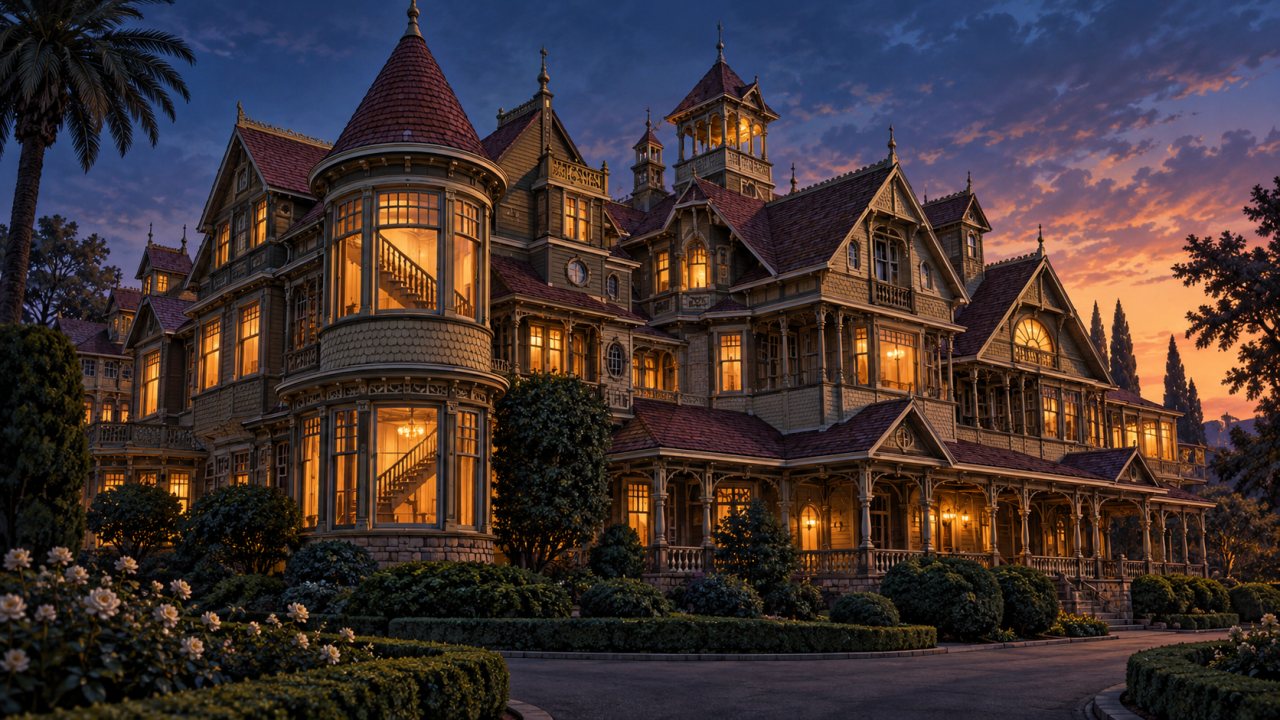
Editorial illustration, not documentary imagery.
On September 5, 1922, Sarah Winchester died inside the California mansion she had spent 36 years expanding. The house contained 160 rooms, staircases leading nowhere, doors opening onto dangerous drops, and windows overlooking other rooms. According to legend, she had been building to protect herself from vengeful spirits. Historical research, however, suggests the real story is considerably more complicated.
The Day Construction Finally Stopped
On September 5, 1922, Sarah Lockwood Pardee Winchester died inside her sprawling Victorian mansion in San Jose, California.
She was the widow of William Wirt Winchester, heir to the Winchester Repeating Arms fortune.
Her death brought an end to an extraordinary residential construction project that had lasted approximately 36 years.
What began as a relatively ordinary eight-room farmhouse had become a 24,000-square-foot mansion with 160 rooms, dozens of staircases, thousands of doors and windows, and a confusing network of corridors.
Some staircases led directly into ceilings. Certain doors opened onto walls, while others opened to the exterior without any landing.
Windows appeared in locations where they provided little obvious benefit.
The house was called Llanada Villa during Sarah's lifetime. It later became internationally famous as the Winchester Mystery House.
In September 2026, the 104th anniversary of Winchester's death renewed attention to the mansion and the legend surrounding its construction.
The central question remains: Why did one woman spend so much of her life building and rebuilding a house that appeared to have no finished design?
A Fortune Built on Winchester Rifles
Sarah Winchester was born in New Haven, Connecticut, in 1839.
In September 1862, she married William Wirt Winchester, son of firearms manufacturer Oliver Winchester.
The family made its fortune producing repeating rifles, including the Winchester Model 1873, popularly associated with the westward expansion of the United States.
Sarah's personal life was marked by several significant losses.
In 1866, she gave birth to a daughter, Annie Pardee Winchester. The infant died approximately five and a half weeks later.
In 1880, Sarah's father-in-law, Oliver Winchester, died.
Only a few months later, in March 1881, William Winchester died from tuberculosis.
Sarah inherited a substantial fortune, reportedly worth approximately $20 million at the time, along with a major ownership interest in the Winchester Repeating Arms Company.
Following her husband's death, she left Connecticut and eventually settled in California.
In 1886, she purchased a farmhouse near San Jose and began expanding it.
The original property occupied a rural landscape of orchards and farmland. Over subsequent decades, it would become almost unrecognizable.
The Legend of the Vengeful Spirits
According to the mansion's most famous legend, Sarah Winchester consulted a spiritual medium after losing her husband and child.
The medium supposedly told her that the Winchester family was being haunted by the spirits of people killed by Winchester rifles.
The dead, according to the story, wanted revenge.
To escape their anger, Sarah was instructed to move west and begin constructing a house.
But there was a condition.
Construction could never stop.
As long as carpenters continued building, Sarah would supposedly remain protected. If the work ended, the spirits would find her, and she would die.
Another version claims the mansion's confusing layout was deliberately designed to mislead ghosts.
Staircases leading nowhere would frustrate pursuing spirits. Doors opening onto walls would trap them. Unusual corridors would prevent supernatural visitors from navigating the building.
The house's architecture appeared to support the narrative.
However, researchers examining Sarah's life have found no reliable contemporary evidence that a medium gave her these instructions or that she actually believed ghosts from Winchester rifles were pursuing her.
The story had become popular long before anyone thoroughly investigated whether it was true.
A Mansion With 160 Rooms
The documented architecture of the Winchester Mystery House is unusual enough without supernatural explanations.
According to the property's official historical records, the mansion eventually included:
- 160 rooms across approximately 24,000 square feet.
- An estimated 2,000 doors and 10,000 windows.
- 47 stairways and 47 fireplaces.
- 52 skylights and 17 chimneys.
- 13 bathrooms and six kitchens.
Its estimated historical construction cost reached approximately $5 million.
The house also included elaborate stained-glass windows, ornate wooden interiors, sophisticated plumbing, and other expensive architectural features.
Sarah was not simply adding inexpensive rooms to an existing farmhouse.
She was commissioning elaborate designs, rebuilding existing spaces, and experimenting with different architectural arrangements.
Some rooms were remodeled more than once.
The property became so large and complicated that visitors could easily lose their sense of direction.
However, the claim that workers hammered, sawed, and constructed new sections continuously, 24 hours a day for 36 years, is not securely established by surviving records.
The mansion's own official website raises the question of whether construction truly never stopped.
The 1906 Earthquake Changed Everything
One of the most overlooked explanations for the house's architectural oddities is the San Francisco earthquake of April 18, 1906.
The earthquake caused extensive damage throughout Northern California, including at Winchester's estate.
Before the disaster, the mansion had reportedly reached seven stories in height.
The earthquake damaged the upper levels so severely that the seven-story tower and most of the fourth floor were subsequently demolished.
This left parts of the house disconnected from their original surroundings.
A staircase that once led to an upper floor could suddenly terminate at a ceiling.
A door that once opened onto a balcony or another structure might become an entrance to nowhere.
A window that originally overlooked an exterior space could become enclosed during subsequent remodeling.
The damage provides a practical explanation for at least some of the strange architectural features associated with the mansion.
Not every unusual feature can be conclusively traced to the earthquake, but the building's changing layout is documented.
Sarah also continued making alterations without following a single comprehensive master plan.
The house was a constantly evolving architectural project rather than a conventional residence constructed according to one fixed design.
Was Sarah Winchester Actually Afraid of Ghosts?
Historian Mary Jo Ignoffo investigated the woman's life for her biography Captive of the Labyrinth: Sarah L. Winchester, Heiress to the Rifle Fortune.
Her research challenged many assumptions surrounding the mansion.
Ignoffo examined personal correspondence, historical newspapers, and surviving records connected to Sarah's life.
She found little evidence supporting the image of a wealthy widow consumed by supernatural fears.
Instead, her findings described an intelligent, private woman with a strong interest in architecture, finances, and property development.
Sarah continued participating in the financial affairs of the Winchester Repeating Arms Company after her husband's death.
She also purchased other properties in California.
Her relocation west was closely connected to family circumstances and health considerations.
According to Ignoffo, Sarah's physician had encouraged her to seek a warmer climate. Other relatives also moved west around the same period.
That explanation directly challenges the story that a psychic ordered her to flee Connecticut.
The historian also found no convincing documentation showing that Sarah regularly conducted séances at the mansion.
Spiritualism was popular during the late nineteenth century, but its popularity does not establish Sarah's personal involvement.
The Mystery of the Number 13
Another famous feature of the Winchester Mystery House is its association with the number 13.
Tourists encounter stories about stairways with 13 steps, windows containing 13 panes, and other architectural details supposedly connected to the number.
Some interpretations suggest Sarah considered 13 a supernatural number with protective powers.
However, Ignoffo's research found no reliable evidence that Sarah was obsessed with it.
In an interview published by the University of Missouri Press, the historian explained that the earliest newspapers describing Winchester's home did not emphasize the number 13.
References to the number began appearing in articles years after Sarah's death.
Ignoffo also cited a former carpenter who reported that some numerical curiosities were added after the house became a tourist attraction.
This raises the possibility that features now presented as evidence of Sarah's supernatural beliefs were partly created or emphasized by later operators.
The historical record does not support attributing every use of the number 13 to Sarah herself.
How the Winchester Mystery House Became a Haunted Attraction
After Sarah died in 1922, her will directed that the property be sold.
The enormous mansion was expensive to maintain, and her relatives did not take it over as a family residence.
The estate was divided, and the property was sold.
In April 1923, John and Mayme Brown leased the house and surrounding grounds.
They initially considered establishing a recreational attraction with gardens, entertainment, and other amusements.
However, visitors became particularly interested in the unusual mansion itself.
On June 30, 1923, the Winchester Mystery House officially opened for public tours.
The property's own history states that approximately 10,000 people attended on opening day.
Over time, supernatural stories became central to the attraction.
Newspaper advertisements promoted the building as a mysterious house associated with spirits and strange construction.
The ghost narrative helped transform a private architectural project into a commercially successful destination.
Historian Ignoffo argues that the mansion's haunted reputation was substantially shaped by early publicity.
The stories were not invented entirely after Sarah's death—newspaper speculation about her motivations existed during her lifetime—but the tourist attraction amplified those claims.
By the time later generations encountered the story, fact and legend had become closely intertwined.
A Haunted House Without Confirmed Ghosts
Visitors have reported unusual sensations and apparent paranormal experiences at the Winchester Mystery House for decades.
Stories involving shadowy figures, mysterious sounds, and unexplained presences remain part of its reputation.
The mansion's layout provides an unusually effective setting for such experiences.
Its narrow corridors, dim rooms, hidden passages, and abrupt architectural transitions can make ordinary sounds and movements difficult to interpret.
The history of the building also creates powerful expectations.
Visitors often arrive already knowing the story of a widow supposedly frightened by supernatural forces.
However, the reported experiences have not established the existence of ghosts inside the mansion.
There is no independently verified evidence proving that deceased victims of Winchester firearms inhabit the property or influenced its construction.
That does not diminish the property's architectural or cultural significance.
The mansion is a documented historical landmark with a remarkable design and an unusually extensive record of alterations.
Its physical structure is real. The supernatural explanation remains unproven.
The Mystery That Survived Sarah Winchester
More than a century after Sarah Winchester's death, the mansion continues operating as a major California tourist attraction.
Its architecture remains unusual by any standard.
Few private homes have undergone comparable expansion, demolition, and remodeling over such an extended period.
The scale of the project raises legitimate questions about Sarah's motivations.
Was she pursuing an elaborate personal architectural vision?
Did expanding the house help her cope with grief?
Was she simply wealthy enough to experiment with construction without worrying about conventional budgets or resale value?
Or did she hold private beliefs that never appeared in surviving correspondence?
The historical evidence supports several ordinary explanations, but it does not establish one definitive motive for every design decision.
Sarah never left a comprehensive public explanation for the mansion.
What researchers have established is that the familiar narrative of a frightened widow desperately constructing rooms to evade ghosts is not supported by strong historical documentation.
The Winchester Mystery House may not have been built to confuse the dead. Its greater mystery is how an ambitious woman's architectural project became one of the most enduring ghost stories in American history.

Jude Cassian
Jude Cassian tracks the strange, dark, unexplained, and absurd corners of the world with independent curiosity and no political or religious spin.
Sources
Suggested Articles You Might Enjoy
The Haunted Boiler of Eldon House: A Repairman Encounters Disappearing Shoes Inside Canada's Historic Mansion
A 2005 Eldon House boiler repair led to reports of sudden physical sensations and vanishing shoes. The alleged diary connection remains unverified.
Canada's Haunted Caribou Hotel: Contractors Report Ghostly Footsteps, Strange Lights, and a Woman Who Died in 1933
At Yukon's Caribou Hotel, restoration workers reported lights without utility power, empty-staircase footsteps, and camera glitches. The haunting remains unverified.
They Built Over a Cemetery: The Real Horror Stories Behind America's Forgotten Burial Grounds
From New York's African Burial Ground to Philadelphia, Tampa, and San Francisco, construction uncovered graves hidden beneath modern development.
Reference
https://timesofindia.indiatimes.com/real-estate/news/on-this-day-104-years-ago-construction-stopped-at-haunted-mansion-inside-winchester-mystery-house/articleshow/133792205.cms
Reference
https://winchestermysteryhouse.com/history/
Reference
https://winchestermysteryhouse.com/timeline/
Reference
https://www.kqed.org/news/11963206/after-100-years-the-mysteries-of-the-winchester-house-endure
Reference
https://umissouripress.blogspot.com/2013/05/author-spotlight-mary-jo-ignoffo.html
Reference
https://www.loc.gov/item/ca0959/
Reference
https://home.nps.gov/places/winchester-house.htm
Reference
https://www.smithsonianmag.com/history/heiress-gun-empire-built-mansion-forever-haunted-blood-money-built-it-180959712/
Reference
https://www.sfchronicle.com/bayarea/article/real-story-of-sarah-winchester-mystery-house-12552842.php
Reference
https://sah-archipedia.org/buildings/CA-01-075-0047