
8 of the Most Haunted Places in Russia
Russia has castles, estates, hospitals, and abandoned buildings wrapped in ghost stories. The legends are dark, but the evidence is more complicated.
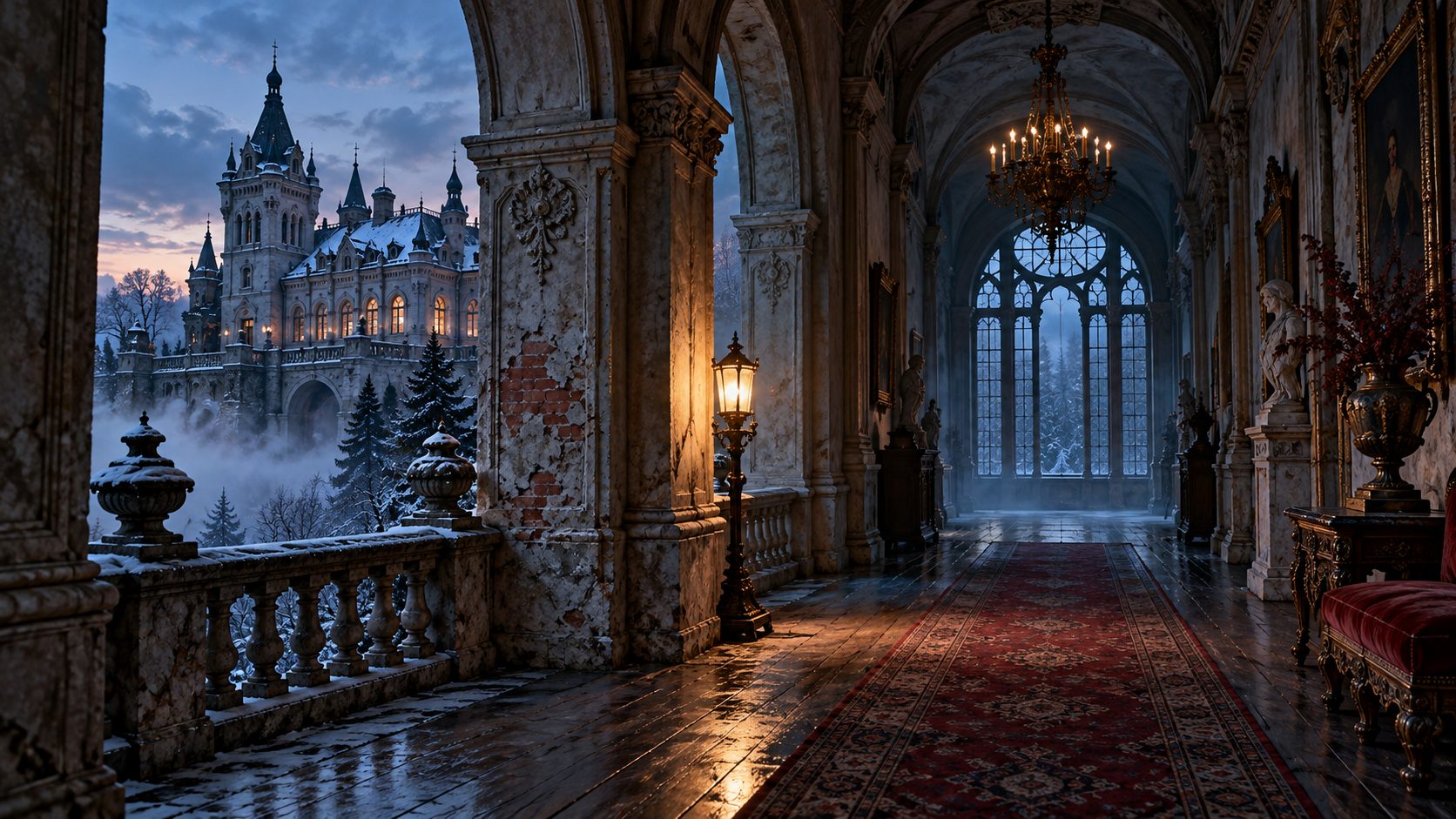
Editorial illustration, not documentary imagery.
Russia has no shortage of locations associated with ghosts, curses, strange noises, unexplained shadows, and people who supposedly never left after death. Many of these stories surround old imperial residences, abandoned estates, hospitals, and buildings connected to violent deaths.
There is an important distinction, however: there is no scientific evidence proving that any of these places is genuinely haunted. Even the Russian Vokrug Sveta article that documents many of the legends acknowledges that no facts confirm the existence of ghosts at these locations. What does exist is a mixture of documented history, decades or centuries of folklore, and eyewitness reports that are difficult or impossible to verify.
1. Glinka Estate - Moscow Region
The Glinka Estate near Losino-Petrovsky is connected to one of Russia's most persistent supernatural legends: Jacob Bruce, a Scottish-descended general, scientist, astronomer, and close associate of Peter the Great.
Bruce was highly educated for his era and worked in astronomy, mathematics, military engineering, and other sciences. That was apparently enough to give him a second reputation as a sorcerer.
Legends claimed Bruce could freeze a pond during summer, fly over his estate on a mechanical dragon, create living dolls, and develop an elixir of immortality. His ghost is now said to wander the estate, supposedly guarding hidden books and treasures.
The historical record is considerably less supernatural. Bruce really did conduct scientific experiments and maintained an observatory and laboratory. Historian Alexander Filimon has argued that Bruce's reputation as a black magician appears to have developed decades after his death, around the early 19th century. Contemporary accounts do not clearly describe him as a sorcerer.
The haunting may be folklore, but the man behind it was real and unusually advanced for his time.
2. The Abandoned Redkino Estate - Leningrad Region
An abandoned estate in Redkino has acquired a darker legend.
The surviving complex includes an old house, outbuildings, and a church with a small cemetery. During the Soviet era, the main building reportedly served as a school. According to a story widely repeated online, a convent once occupied the property before mysteriously disappearing along with all of its nuns.
Visitors have subsequently claimed to hear voices inside empty buildings and see shadows moving across walls.
There is a problem: researchers have found little historical support for the vanished-convent story. Even Vokrug Sveta characterizes it as probably a legend rather than established history.
Redkino illustrates how abandoned architecture can develop a supernatural history that becomes more elaborate with each retelling.
3. Palace of the Oldenburgs - Ramon
The red-brick Palace of the Oldenburgs in Russia's Voronezh region looks almost designed for ghost stories. Built in the late 19th century for Princess Eugenia of Oldenburg, the estate resembles a European medieval castle and survives today as a museum complex. Official regional tourism records confirm its connection to the Russian branch of the House of Oldenburg.
Its supernatural reputation involves several alleged ghosts.
One is the White Girl, supposedly a servant who died after being sent into freezing weather. Another is the Lady in the Black Veil, described as resembling Princess Eugenia herself.
The darkest legend concerns an unnamed sorcerer who allegedly cured Eugenia of an illness and then demanded her love as payment. After being rejected, he was supposedly executed and cursed the palace before dying.
There is no reliable historical documentation confirming this dramatic story. The palace is real; the curse belongs to folklore.
4. The Povalishin Estate - Smolensk Region
The ruined Vasilyevskoye estate in the Smolensk region was associated with the Povalishin noble family and today survives in a heavily deteriorated condition. Heritage records confirm the estate's historical buildings and trace its development to the late 18th and early 19th centuries.
Its unusual layout helped create its paranormal reputation.
The estate has been associated with Freemasonry, and visitors point to apparently symbolic structures in the grounds, including a pyramid-shaped mound and a corresponding depression. Stories claim that secret messages were incorporated into the architecture.
Local folklore goes further. Some visitors report sudden weakness, nausea, or an oppressive feeling after entering the property, supposedly caused by the spirits of its former owners. Other visitors experience nothing unusual at all.
No evidence demonstrates that the physical symptoms have a paranormal cause.
5. Elsa's Dacha - Pyatigorsk
Elsa's Dacha is one of Russia's most visually convincing haunted houses.
The three-story mansion was constructed in the early 20th century and resembles a small medieval castle. Government heritage records identify the building as Dacha "Elsa," dating to 1904 and designed by architect S.N. Gushchin.
Its original owner, Elsa Gukasova, operated the building as a boarding house. After the Russian Revolution, the property was nationalized, while Elsa's ultimate fate became the subject of competing stories.
One legend says she hid treasure inside the mansion and was later murdered after refusing to reveal its location. An even darker version claims her body was sealed somewhere inside the building.
Later occupants supposedly reported screams, footsteps, severe headaches, anxiety, and the sensation of being watched. A concrete slab in the lower part of the house became known as "Elsa's grave," despite the lack of evidence that her body was ever there.
Elsa's Dacha remains one of the stronger examples of documented architecture becoming inseparable from an undocumented death story.
6. Meshkov House - Perm
Meshkov House stands near the Kama River in Perm and is now part of the Perm Regional Museum.
The documented history is straightforward. The current building was constructed in 1889 for businessman and philanthropist Nikolai Meshkov and later passed through numerous uses and owners.
Its ghost story is considerably more disturbing.
Local folklore portrays Meshkov as a womanizer whose lovers sometimes returned months later and abandoned newborn babies at his doorstep. According to the legend, some infants froze to death during the severe Russian winter.
Their cries are supposedly still heard near the mansion at night.
The museum itself does not confirm the ghost stories.
There is also little reliable documentation supporting the abandoned-infants story, making this another case where local legend is far stronger than the available historical evidence.
7. The Former Prison Hospital - Novosibirsk
A red-brick building in central Novosibirsk, today connected with the regional administration for cultural-heritage protection, reportedly once served as a hospital for prisoners.
According to the local story, the hospital became severely overcrowded during a typhus epidemic in the 1920s. Prisoners were supposedly transported there through an underground passage, and some died in its basement rooms.
Stories of paranormal activity include unexplained noises, moving shadows, and apparitions. One legend attributes the ghost to a dead prisoner; another associates it with a former merchant who mysteriously disappeared.
As with many haunted locations, the historical use of the building provides a plausible foundation for the legend, while the supernatural details remain anecdotal.
8. Mikhailovsky Castle - St. Petersburg
Mikhailovsky Castle has perhaps the strongest historical foundation for a Russian ghost story because the violent death at the center of the legend unquestionably happened.
Emperor Paul I was assassinated inside the castle in March 1801, only weeks after moving into his new residence.
The emperor supposedly never left.
Stories describe Paul's ghost walking through the castle carrying a candle. Guards and employees have allegedly heard footsteps, doors closing, and floorboards creaking in empty rooms. Other legends claim ravens gather around the building on the anniversary of his murder.
Russia's Culture.ru notes an important detail: the ghost story appears to have developed after the castle became home to the Main Engineering School. Cadets may have been responsible for spreading or even inventing stories of the murdered emperor wandering the corridors.
That does not make the legend less enduring. Two centuries after Paul's assassination, Mikhailovsky Castle remains one of Russia's best-known supernatural locations.
Are Russia's Haunted Places Really Haunted?
Science cannot currently establish that ghosts are responsible for the experiences reported in these buildings.
A 2020 review in Frontiers in Psychology examined 66 studies involving reportedly haunted environments. Researchers considered temperature, lighting, air quality, electromagnetic fields, infrasound, and other environmental variables. Results were generally inconsistent, and no single physical mechanism adequately explained haunted-house experiences.
Psychological expectation appears important. In a controlled "Haunt" experiment, researchers exposed participants to electromagnetic fields and infrasound while they spent time in a specially constructed room. People reported strange sensations, including feelings commonly associated with haunted locations, but those experiences did not correspond reliably with the experimental environmental conditions. Researchers concluded that suggestion and expectation were likely major factors.
That still leaves Russia's haunted buildings with something science cannot erase: their histories.
Murdered emperors, abandoned mansions, unexplained disappearances, epidemics, political upheaval, and centuries of folklore created environments where stories persist long after the people involved are dead.
Whether anything is actually walking the corridors is a different question.

Jude Cassian
Jude Cassian tracks the strange, dark, unexplained, and absurd corners of the world with independent curiosity and no political or religious spin.
Sources
Suggested Articles You Might Enjoy
Seoul's Ghost Culture vs. America: The Dead Play by Different Rules
Seoul's ghosts and America's ghosts may look familiar at first glance, but Korean gwishin, shamanic ritual and haunted American places follow different cultural rules.
They Built Over a Cemetery: The Real Horror Stories Behind America's Forgotten Burial Grounds
From New York's African Burial Ground to Philadelphia, Tampa, and San Francisco, construction uncovered graves hidden beneath modern development.
Canada's Haunted Caribou Hotel: Contractors Report Ghostly Footsteps, Strange Lights, and a Woman Who Died in 1933
At Yukon's Caribou Hotel, restoration workers reported lights without utility power, empty-staircase footsteps, and camera glitches. The haunting remains unverified.
Reference
https://www.vokrugsveta.ru/articles/obiteli-dukhov-7-samykh-zhutkikh-domov-s-privideniyami-v-rossii-id901310/
Reference
https://www.vokrugsveta.ru/article/304068/
Reference
https://www.culture.ru/materials/185500/okhota-za-privideniyami
Reference
https://www.culture.ru/materials/257662/russkie-legendy
Reference
https://visitvrn.ru/wp-content/uploads/2022/06/REESTR-TURRESURSOV-VO-obnovlennyj.pdf
Reference
https://www.culture.ru/institutes/24260/dom-meshkova
Reference
https://base.garant.ru/412435336/
Reference
https://nbcrs.org/regions/smolenskaya-oblast/usadby-i-usadebnye-kompleksy
Reference
https://www.frontiersin.org/journals/psychology/articles/10.3389/fpsyg.2020.01328/full
Reference
https://www.sciencedirect.com/science/article/pii/S0010945208001299