
How They Catch Ghosts in Russia: Inside the Methods of Russian Paranormal Investigators
Russian paranormal investigators use cameras, EMF meters, EVP recordings, Kinect sensors, dosimeters and long surveillance sessions, but most cases still collapse into ordinary explanations.
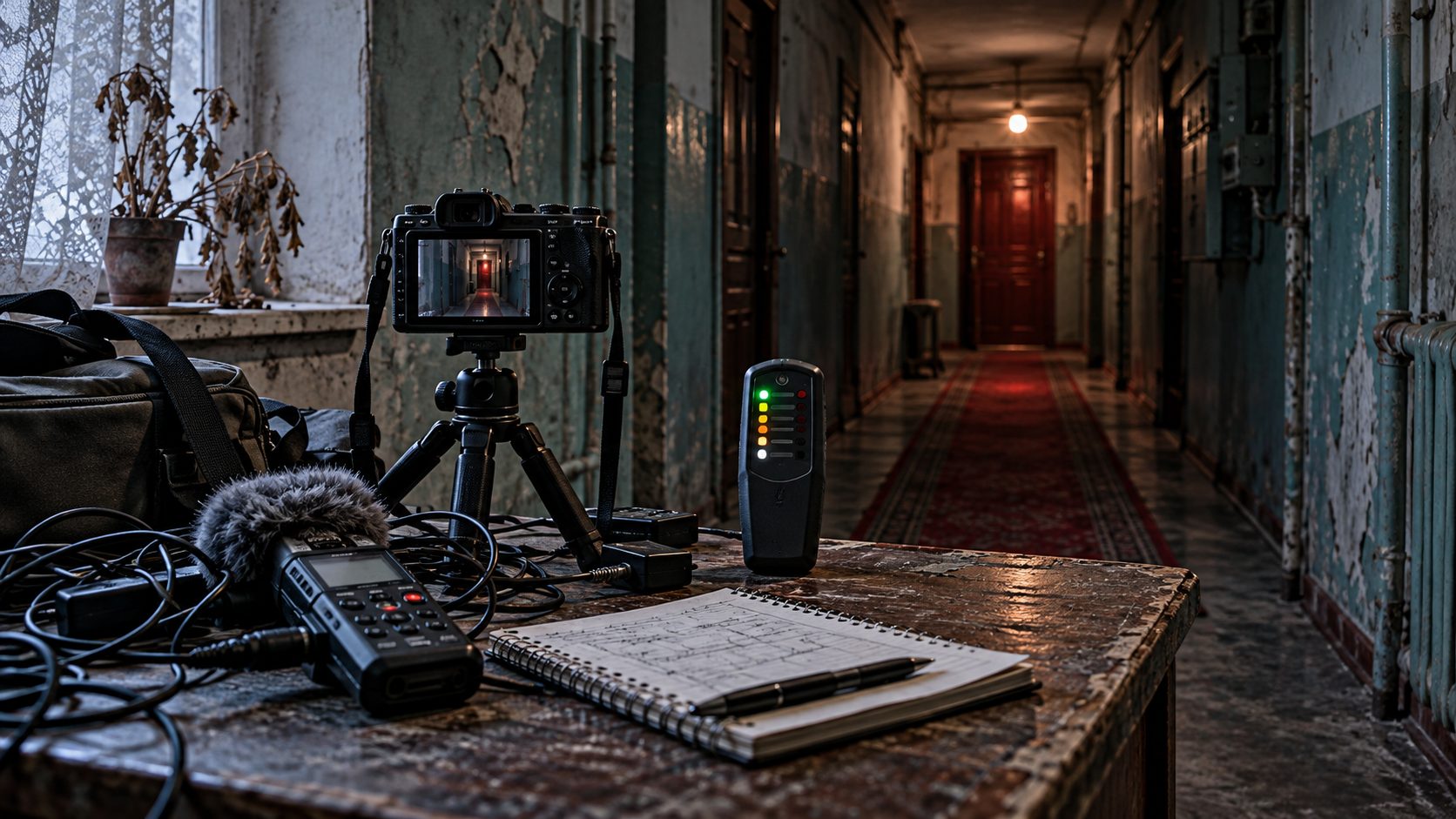
Editorial illustration, not documentary imagery.
Russian ghost hunters are not walking through abandoned buildings with proton packs. Their equipment looks more like a mixture of a surveillance kit, an electrician's toolbox, and experimental electronics: infrared cameras, electromagnetic-field meters, audio recorders, dosimeters, laser grids, motion sensors, random-number generators, and devices that rapidly scan radio frequencies.
A June 2026 investigation by Russian outlet Life.ru interviewed three groups that have spent years investigating alleged ghosts and poltergeists across Russia. Their approaches differ significantly. Some actively attempt to communicate with spirits. Others begin by looking for bad electrical wiring, radiation, environmental noise, equipment malfunction, or mistakes made by frightened witnesses.
The important point is that none of these methods has been scientifically demonstrated to detect ghosts. What Russian investigators are actually trying to catch is evidence: an unexplained sound, movement, image, electromagnetic change, or physical event that survives ordinary explanations.
First Step: Find Out What Actually Happened
Nikita Tomin, an Irkutsk-based researcher associated with the Russian anomalous-phenomena organization Kosmopoisk, told Life.ru that an investigation normally starts with witness interviews.
If people report footsteps in an empty apartment, objects moving, voices, apparitions, or spontaneous fires, investigators first reconstruct where the witnesses were standing, when the events happened, how frequently they occurred, and whether multiple people observed the same thing.
Then comes environmental monitoring.
Tomin's team measures various physical fields around the location before deciding whether a case deserves prolonged investigation. If something unusual continues, cameras may be installed in the property for extended surveillance, and specialists may be brought in to examine individual anomalies.
This is considerably less dramatic than television ghost hunting, but it addresses an important problem: houses are full of things capable of producing apparently paranormal effects.
Electrical systems create electromagnetic fields. Pipes vibrate. Buildings expand and contract with temperature. Rodents move inside walls. Radio signals interfere with electronics. Reflections appear unexpectedly on cameras. Old furniture shifts. Carbon monoxide and other environmental conditions can affect occupants.
Moscow investigator Georgy Fyodorovsky takes a similar approach. His group, whose Russian name translates roughly as "Real Ghost Hunters," uses electromagnetic meters, radiation detectors and random-number generators. Fyodorovsky told Life.ru that the group specifically searches for conventional explanations, including radiation from building materials and electromagnetic emissions from electrical wiring.
The Russian Ghost Hunter's Equipment
Other Russian investigators go considerably further.
Twin brothers Andrey and Sergey Shevelev have investigated paranormal claims since 2017. Their equipment reportedly includes:
- night-vision cameras;
- electromagnetic-field detectors;
- Spirit Box and homemade Ghost Box devices;
- cassette and digital audio recorders;
- an Xbox Kinect camera;
- Polaroid cameras;
- lasers;
- infrared illumination;
- and other experimental equipment.
They are particularly interested in Electronic Voice Phenomena, or EVP: sounds discovered on recordings that investigators interpret as voices that were not audible at the time.
The procedure is simple. Investigators enter a reportedly haunted location, ask questions aloud, leave periods of silence, record the environment and later listen carefully to the audio.
A faint syllable buried in static may sound like a name or answer.
The Shevelev brothers claim that some recordings appear to provide surprisingly relevant responses to questions. They also experiment with forms of alleged instrumental transcommunication, in which video, audio, water reflections, radio noise, and other ambiguous signals are examined for apparent messages.
Scientists offer a much less supernatural explanation for EVP.
Psychologist Michael Nees and Charlotte Phillips tested purported EVP recordings and found that telling listeners they were hearing paranormal material increased their tendency to detect voices in ambiguous sounds. Agreement about what those supposed voices actually said was low. This is consistent with auditory pareidolia, the brain's tendency to identify meaningful speech in random or unclear noise.
A later study published in PLOS One also found evidence that paranormal expectations can affect what listeners believe they hear in EVP recordings.
Can a Kinect Camera See a Ghost?
One of the strangest tools in Russian and Western ghost hunting is the Microsoft Xbox Kinect.
Kinect was designed to recognize human players. Its infrared system maps a room and software attempts to identify a human skeleton from the shapes it detects.
Ghost hunters discovered that, occasionally, Kinect displays human-shaped stick figures when nobody appears to be standing there.
Some interpret these figures as invisible entities.
The problem is that Kinect was never designed as a paranormal detector. Its software is deliberately trying to construct human shapes. Investigators testing the technology have demonstrated that furniture, bags, clothing and other objects can cause false skeletal detections.
In other words, a Kinect ghost proves that the software thinks it found a body-shaped pattern, not that an invisible body exists.
The Cemetery Face and the Alleged Attached Poltergeist
The Shevelev brothers told Life.ru that one of their earliest cemetery investigations produced something disturbing during later video review: what appeared to be the face of an elderly woman in a frame.
They also report hearing voices in abandoned places where they believed nobody else was present.
Andrey Shevelev describes an even stranger incident after one cemetery investigation. He believes some kind of entity followed him home to his rented apartment.
According to his account, objects moved and unexplained knocks occurred until he eventually moved out. He interprets the events as a poltergeist attached to him after visiting the cemetery.
That interpretation is part of paranormal belief, not an established scientific mechanism. There is no evidence that cemeteries become more paranormally active after a specific hour or that spirits can attach themselves to visitors.
The Tripod That Appeared to Move by Itself
Tomin describes one of his group's strangest cases at a site near Irkutsk known as the Dacha of the Moon King.
The location has long been associated with stories of shadowy figures. In August 2012, investigators placed four cameras around the property during a nighttime investigation.
One camera reportedly recorded a tripod moving unexpectedly.
Tomin says a specialist later examined the movement and considered it unusual. The footage remains interesting to the investigators, but it does not independently establish what moved the equipment. Without multiple synchronized camera angles, environmental measurements and controlled reconstruction of the event, identifying an unknown force is extremely difficult.
This problem affects almost every impressive ghost video: recording something unexplained is not the same as determining what caused it.
The Ghost Pianist of Angarsk
Another case brought Tomin's investigators to a building in Angarsk after a security guard complained about nighttime activity.
Tomin says investigators heard what sounded like children's footsteps while the building was empty. He also claims they witnessed the guard apparently being pushed and recorded piano sounds that seemed to occur without anyone playing the instrument.
The team retained audio recordings from the investigation.
Again, the recordings demonstrate that sounds were recorded. Establishing their source is a separate problem.
A scientific investigation would need to rule out acoustic transmission from another room or neighboring building, mechanical problems with the piano, structural vibration, animals, hidden participants, radio interference and deliberate manipulation before concluding that the source was paranormal.
A Dead Man's Apartment in Moscow
Fyodorovsky's group investigated an apartment near Moscow's Babushkinskaya metro station after the owner died.
According to the account given to Life.ru, neighbors heard sounds from the empty apartment and apparently saw lights operating inside. The dead man's son later entered and claimed that an old television switched on by itself.
The investigators installed surveillance equipment for approximately a week.
The result was surprisingly inconclusive.
They did not capture anything definitive.
Investigators reported uncomfortable sensations and claimed that objects occasionally seemed to appear in places they had previously cleared, but Fyodorovsky acknowledged that cognitive errors could explain at least some of these observations.
He later described seeing a human-like shadow for only a few seconds during a separate investigation at the Meyerhold museum-house in Penza. It remains his strongest personal visual experience, but not independently verified evidence of a ghost.
Russian Ghost Hunters Admit Most Cases Are Not Ghosts
Perhaps the most revealing statement in the Life.ru investigation comes from Tomin himself.
Based on his experience, he estimates that 95-97% of cases his group receives are caused by cognitive distortions, observational mistakes, or people simply misinterpreting what happened.
That estimate puts Russian paranormal investigation into perspective.
Most calls do not result in a ghost.
Investigators may find environmental causes, misunderstandings or nothing unusual at all. A small residual category remains unexplained, not necessarily because it is supernatural, but because investigators lack enough information to determine what occurred.
Mainstream research into haunted locations reaches a similar conclusion from a different direction. A major review published in Frontiers in Psychology examined environmental research involving purportedly haunted places. Temperature, electromagnetic fields, air quality, infrasound, lighting and other factors have all been investigated, but no reliable environmental signature identifying the presence of a ghost has emerged.
Researchers in the controlled Haunt Project deliberately exposed participants to electromagnetic fields and infrasound. Participants reported unusual sensations traditionally associated with haunted places, but the experiences were not reliably connected to the manipulated conditions. The researchers concluded that suggestion may play an important role.
So How Do They Catch a Ghost in Russia?
They do not catch one in the literal sense.
Russian paranormal investigators attempt to trap an event inside data.
They leave cameras running overnight. They record hours of silence. They monitor radiation and electromagnetic fields. They scan radio frequencies. They use infrared cameras to watch rooms humans cannot see clearly in the dark. They compare witness testimony with environmental measurements. And sometimes they return home with a strange voice, moving shadow, unexplained knock or piece of footage they cannot immediately explain.
For believers, those remnants are evidence that something survives death.
For skeptics, they are examples of incomplete data, equipment artifacts, pareidolia, expectation and ordinary events occurring under unusual circumstances.
The most credible Russian investigators appear to recognize that distinction themselves.
If 95% or more of alleged hauntings disappear under investigation, the interesting question is not whether every mysterious noise is a ghost.
It is what remains after everything ordinary has been eliminated.

Jude Cassian
Jude Cassian tracks the strange, dark, unexplained, and absurd corners of the world with independent curiosity and no political or religious spin.
Sources
Suggested Articles You Might Enjoy
Canada's Haunted Caribou Hotel: Contractors Report Ghostly Footsteps, Strange Lights, and a Woman Who Died in 1933
At Yukon's Caribou Hotel, restoration workers reported lights without utility power, empty-staircase footsteps, and camera glitches. The haunting remains unverified.
The Haunted Boiler of Eldon House: A Repairman Encounters Disappearing Shoes Inside Canada's Historic Mansion
A 2005 Eldon House boiler repair led to reports of sudden physical sensations and vanishing shoes. The alleged diary connection remains unverified.
Haunted Homes Under Renovation: St. Louis Contractors Report Ghostly Figures, Moving Doors, and a Serious Ladder Accident
A St. Louis remodeler reported strange figures, lights, a moving attic door, and a serious ladder fall at two homes. Physical explanations remain unruled out.
Reference
https://life.ru/p/1892954
Reference
https://www.irk.ru/news/articles/20171031/ghost/
Reference
https://onlinelibrary.wiley.com/doi/full/10.1002/acp.3068
Reference
https://journals.plos.org/plosone/article?id=10.1371%2Fjournal.pone.0274595
Reference
https://www.frontiersin.org/journals/psychology/articles/10.3389/fpsyg.2020.01328/full
Reference
https://pubmed.ncbi.nlm.nih.gov/18635163/
Reference
https://skepticalinquirer.org/exclusive/the-xbox-kinect-and-paranormal-investigation/